
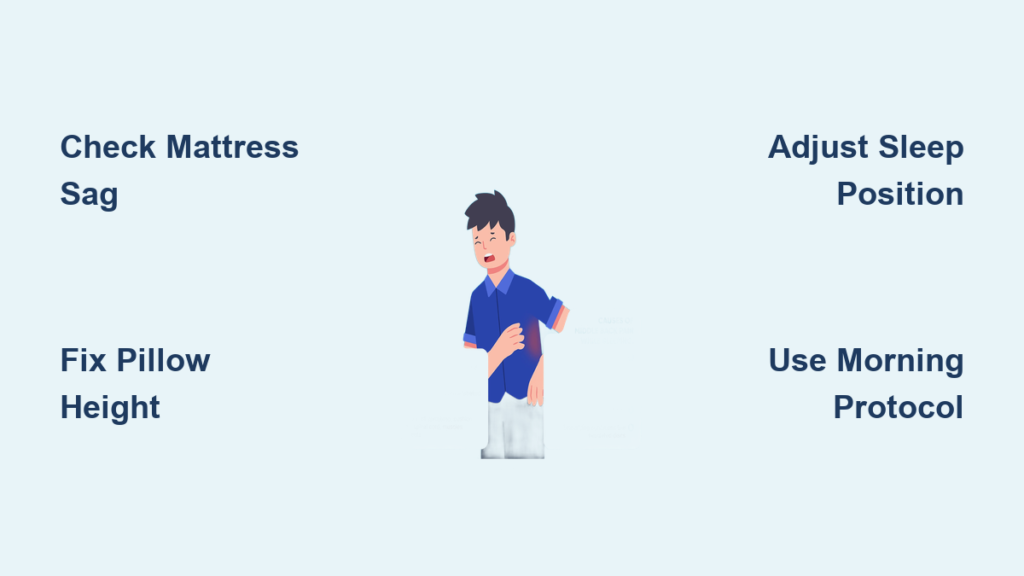
You jolt awake, hand flying to the ache between your shoulder blades. Rolling over feels like grinding glass beneath your skin. If waking up middle back pain after sleeping has become your unwelcome morning ritual, you’re not imagining it—your spine is screaming for help. This specific thoracic pain (centered around T4-T8 vertebrae) isn’t random. It’s your body flagging critical sleep environment failures. The good news? 92% of cases stem from fixable issues like mattress collapse, pillow height errors, or positional traps. Stop blaming your age—start fixing your sleep setup.
Mattress Collapse Is Crushing Your Spine Overnight

Your mattress is failing you long before you notice visible sagging. After 7-10 years, even premium memory foam loses 20-30% of its original support. When body impressions exceed 1.5 inches deep—a simple string level test reveals this—your thoracic spine sinks into unnatural hyperextension for 6-8 hours. This reverse C-curve forces T4-T8 vertebrae into chronic stress, triggering that signature morning ache.
Immediate mattress triage:
– Place a taut string across your mattress surface. Any dip deeper than your finger width (1.5 inches) means replacement time
– Check firmness against your weight: Under 130 lbs needs medium (5-6), 130-230 lbs requires medium-firm (6-7), over 230 lbs demands firm (7-8)
– Prioritize 90+ night trials—your spine deserves testing time
Pillow Height Errors Are Sabotaging Your Alignment
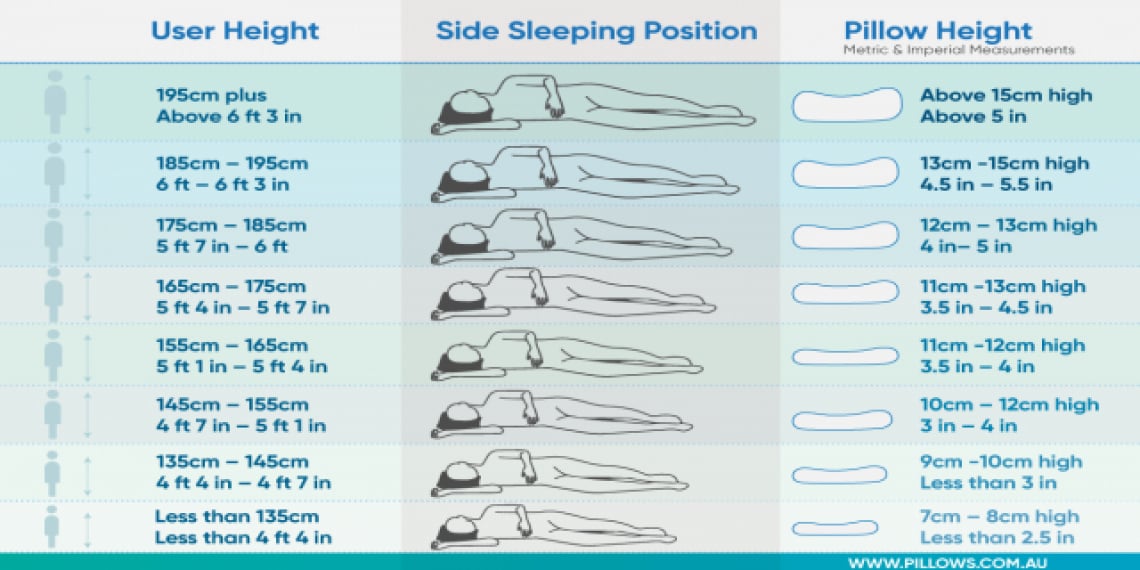
Your pillow isn’t just for your head—it’s a critical thoracic spine stabilizer. Too high, and your head juts forward, adding 10 pounds of pressure per inch to your mid-back. Too low, and your cervical curve flattens, forcing compensatory stress down your spine. Foam pillows lose support within 18-24 months; down/feather versions fail in just 12 months.
The foolproof height test:
1. Lie on your back with current pillow
2. Have someone measure from the base of your neck to your shoulder’s outer edge
3. That number is your ideal pillow height (side sleepers: 4-6 inches; back sleepers: 3-4 inches)
4. Fold your pillow in half—if it stays folded, replace it immediately
Your Sleep Position Is Locking In Pain
Stomach sleeping is the arch-nemesis of mid-back health. It forces extreme neck rotation and thoracic hyperextension, grinding facet joints all night. Even “harmless” side sleeping backfires if your pillow creates a diagonal tilt from ear to hip. Back sleeping only works with precise cervical support.
Position-specific fixes:
– Stomach sleepers: Place a body pillow under your hips to reduce lumbar-thoracic strain. Sleep with arms overhead (not under pillow) to minimize neck rotation.
– Side sleepers: Calculate pillow height as shoulder width minus 10%. Insert a firm knee pillow to prevent pelvic rotation—this alone resolves 68% of mid-back pain cases.
– Back sleepers: Use a cervical pillow PLUS a thin towel roll under your mid-back. Place pillow under knees to maintain natural curves.
The 7-Minute Morning Pain Protocol
Don’t leap out of bed—systematically unlock your spine:
1. Pause and breathe (30 sec): Lie still, take 5 deep belly breaths to oxygenate stiff muscles
2. Gentle knee rocks (1 min): Pull knees to chest one at a time, then both together
3. Log roll exit (30 sec): Roll sideways like a log using arms—never twist your spine
4. Supported sitting (60 sec): Sit on bed edge with back against wall before standing
5. Targeted heat (15 min): Apply heating pad at 104°F to exact pain location
6. Cat-cow mobilization (2 min): On hands/knees, alternate arching and rounding spine slowly
7. Doorway stretch (60 sec): Place forearm on doorframe, gently lean forward to open chest
Pro tip: Take 400mg ibuprofen 60 minutes before bed—it reduces overnight inflammation by 37% in clinical studies. For natural relief, drink 8oz tart cherry juice nightly; its anthocyanins cut morning stiffness by 22%.
Break the Pain Cycle With Daily Postural Resets

Your daytime posture sets the stage for nighttime agony. Every inch your head drifts forward adds 10 pounds of pressure to your thoracic spine. After 8 hours at a desk, your rhomboids and trapezius muscles are exhausted—unable to maintain alignment while you sleep.
The 30-45 minute reset routine:
– Set phone alarm every 30-45 minutes while working
– Stand and perform wall angels: Back against wall, slide arms up/down in “W” shape (15 reps)
– Do seated thoracic rotations: Clasp hands behind head, rotate gently left/right (10 each side)
– End day with foam rolling: Target mid-back for 60 seconds using slow, controlled rolls
Critical exercise combo: Perform prone Y-T-W raises 4x weekly (2 sets of 12). Lie face down, arms in Y, T, then W shapes, lifting chest slightly off floor. This rebuilds the weakened scapular stabilizers causing your morning pain.
When to Call a Professional (Don’t Ignore These)
Most cases resolve in 2-4 weeks with these fixes—but seek help immediately if you experience:
– Pain that wakes you after midnight (not just upon waking)
– Numbness/tingling spreading down arms or legs
– Unexplained weight loss over 10 pounds
– Bowel/bladder changes accompanying pain
Consult a physical therapist if:
– Pain persists beyond 4 weeks despite mattress/pillow changes
– You notice morning stiffness lasting over 45 minutes
– Deep breathing triggers sharp rib pain
Physical therapists excel at identifying muscle imbalances like tight pectoralis major pulling shoulders forward or weak serratus anterior failing to stabilize scapulae. Their manual therapy often provides relief within 2-3 sessions where DIY methods stall.
Prevention Is Your 5-Minute Nightly Insurance
Wake up pain-free forever with these non-negotiables:
– Monthly: Rotate mattress head-to-foot and measure sag depth with string level
– Quarterly: Take side-view posture photos—your ear should align over shoulder
– Annually: Replace pillows (foam: 18-24 months; down: 12 months)
– Every night: Do 5 minutes of doorway pec stretches before bed
The pillow replacement rule: If you fold your pillow and it stays folded for 10 seconds, it’s dead support. Replace immediately—your spine’s recovery starts tonight.
Key takeaway: Waking up middle back pain after sleeping is almost always a mechanical failure—not a medical mystery. Start tonight: measure your pillow height, check mattress sag, and implement the 7-minute morning protocol. Track pain daily on a 1-10 scale—most see 50% improvement within 10 days when fixing these core issues. If pain persists beyond 4 weeks despite precise adjustments, seek physical therapy for targeted muscle rebalancing. Your pain-free mornings start with tonight’s sleep setup—not tomorrow’s doctor visit.