
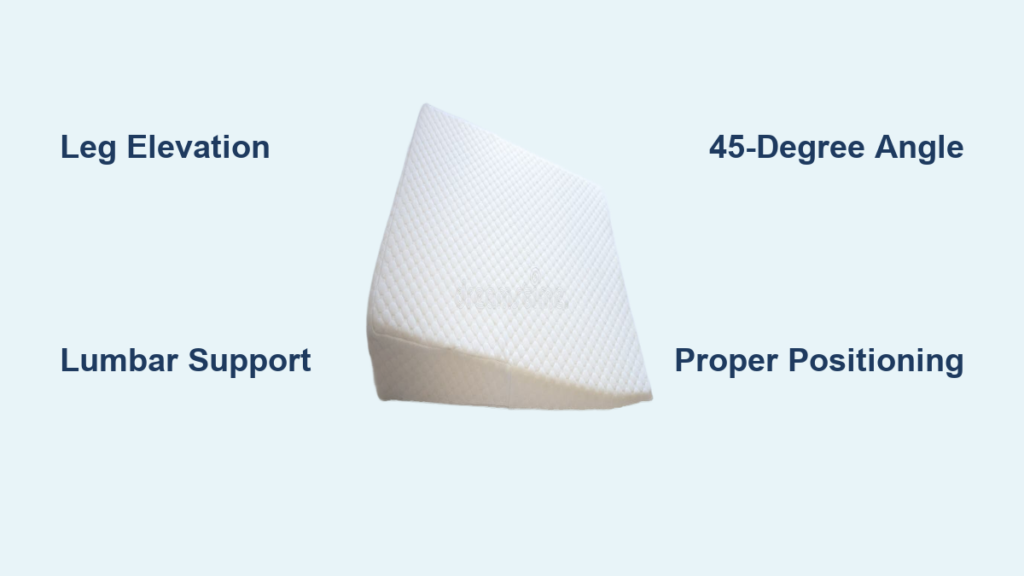
Waking up with a stiff lower back or feeling that familiar ache after a long day? You’re not alone—back pain affects millions daily, but relief might be simpler than you think. A wedge pillow with its precise 45-degree angle isn’t just another cushion; it’s a therapeutic tool designed to decompress your spine while you rest. Whether you’re dealing with sciatica flare-ups, herniated disc discomfort, or just everyday tension, mastering proper wedge pillow positioning can transform your sleep and daily comfort.
This guide breaks down exactly how to position your wedge pillow for maximum back pain relief, covering everything from leg elevation techniques to back support configurations that actually work. No vague advice here—just specific, science-backed methods that deliver results.
Precision Leg Elevation for Instant Spinal Decompression

Correct Knee Support Positioning
Place the wedge pillow under your knees while lying flat on your back. The elevated section should run from just behind your knees to your mid-thigh, creating that crucial 45-degree angle. This positioning immediately removes gravitational pressure from your lumbar spine, allowing the vertebrae to decompress naturally.
Key positioning check: Your heels should rest comfortably on the mattress, not dangling in the air. If your feet are elevated too high, slide the pillow slightly lower under your calves. The goal is knee support, not full leg elevation.
Pro tip: Start with 15-20 minute sessions to let your body adjust to the new positioning. Many users feel immediate relief, but your muscles may need time to fully relax into the decompressed position.
When to Use Leg Elevation for Maximum Benefit
Leg elevation works best during sleep and extended rest periods when your body needs consistent decompression. The memory foam adapts to your leg shape while maintaining the therapeutic angle throughout the night.
Common mistake: Placing the wedge too high under your thighs instead of behind your knees creates pressure points that counteract the decompression effect. Position the wedge so your knee joint rests at the transition point between the flat and angled surfaces.
Time-saving shortcut: Keep the wedge permanently positioned at the foot of your bed. Slide it into place before sleep rather than trying to position it while already lying down—this prevents straining your back during setup.
Targeted Back Support Configurations That Actually Work

Lumbar Curve Enhancement Technique
Flip the wedge to support your lower back instead of your legs. Position the wide base of the wedge at your waist level, with the angled portion supporting your lumbar curve. This creates gentle elevation that maintains your spine’s natural S-curve while providing targeted support to the lumbo-sacral region.
When to use: This configuration works best for reading, watching TV, or when acid reflux accompanies your back pain. The elevation angle helps both conditions simultaneously by reducing pressure on the digestive system while supporting proper spinal alignment.
Visual cue: Your lower back should feel comfortably cradled, not forced into an unnatural arch. If you feel pressure in your tailbone area, slide the wedge slightly upward toward your mid-back.
Sciatica-Specific Relief Protocol
The 45-degree leg elevation angle specifically targets sciatic nerve compression by creating space between vertebrae. When positioned correctly, the wedge lifts the weight of your legs off your lower spine, reducing pressure on the sciatic nerve roots.
Daily protocol: Use during sleep for 6-8 hours, or during flare-ups for 30-minute sessions. The memory foam adapts to your leg shape while maintaining consistent elevation, preventing nerve pinching that causes radiating leg pain.
Warning signs to watch: If pain increases during positioning, adjust the angle or consult your healthcare provider. Proper wedge use should feel relieving, not aggravating—your body should feel lighter, not compressed.
Circulation Optimization for Faster Healing
Blood Flow Enhancement Method
The specific 45-degree angle targets your hip flexor region, creating optimal conditions for circulation. This positioning reduces stress in the thoraco-lumbar regions by supporting hip flexors, promoting venous return from your lower extremities.
Best practice: Combine wedge positioning with gentle ankle rotations. This pumps blood back toward your heart while the wedge prevents pooling in your legs—a double benefit for those dealing with edema or circulation issues.
Pro tip: For maximum circulatory benefit, use the wedge pillow immediately after prolonged sitting. The decompression effect helps reverse the negative impact of sedentary positions on spinal health.
Herniated Disc Recovery Strategy
For bulging or herniated discs, alternate between leg elevation and back support throughout the day. The decompression effect reduces pressure on affected discs while the back support configuration maintains proper spinal alignment during activities.
Recovery timeline: Most users report noticeable improvement within 3-7 days of consistent use. The key is maintaining proper positioning for extended periods—your body needs time to heal in the correct alignment.
Critical mistake to avoid: Using the wedge pillow at the wrong angle (steeper than 45 degrees) can increase pressure on affected discs. Verify your angle using a book test—place a book on your thigh while positioned; it should remain relatively level.
Size-Specific Positioning for Maximum Effectiveness

Height-Based Sizing Guide
The small wedge pillow works best for individuals 5’2″ to 5’6″. If you’re taller, your knees may extend beyond the pillow’s support zone, reducing therapeutic effectiveness. Shorter users might find their feet elevated too high, creating strain rather than relief.
Quick sizing test: Lie flat and measure from the back of your knee to where the wedge ends. You want support to reach mid-thigh without overshooting. If you fall outside the recommended height range, consider a larger or smaller wedge size.
Expert note: Many users don’t realize that improper sizing is the primary reason wedge pillows seem ineffective. The 45-degree angle only delivers therapeutic benefits when properly proportioned to your body dimensions.
Angle Verification Method
Confirm your 45-degree angle by placing a book on your thigh while using the wedge. The book should remain relatively level—not sliding toward your feet or head. This visual check ensures you’re getting the full therapeutic benefit.
Troubleshooting tip: If the book slides downward, add a thin pillow under your feet to level the angle. If it slides upward, you’ve positioned the wedge too high—slide it downward slightly toward your calves.
Daily Usage Strategies for Sustained Relief
Overnight Positioning Protocol
For overnight relief, position the wedge before getting into bed. Center it where your knees will naturally fall when lying down. Many users find securing the wedge with a pillowcase helps prevent shifting during sleep.
Morning routine: Before getting up, remove the wedge and gently roll to your side. This prevents sudden pressure changes on your spine after hours of decompression.
Time estimate: Proper setup takes less than 30 seconds but delivers 6-8 hours of therapeutic benefit. Consistency is key—use the same positioning every night for optimal results.
Transitioning Between Configurations
Switch from leg elevation to back support by simply sliding the wedge upward or downward. The memory foam construction makes repositioning effortless while maintaining therapeutic support.
Timing strategy: Use leg elevation for sleep and back support for evening relaxation. This dual approach addresses different pain patterns throughout your daily cycle—decompression during rest and support during activity.
Pro tip: Keep two wedge pillows if you share a bed—one positioned for your needs at the foot of the bed, another for your partner’s comfort needs.
Maintenance for Long-Term Therapeutic Value
Cleaning Without Losing Shape
Remove the Sherpa cover by unzipping and turn it right side out before washing. Use cold water only and lay flat to dry—never machine dry, as heat can warp the memory foam core.
Maintenance schedule: Wash the cover weekly if using daily, bi-weekly for occasional use. The foam itself rarely needs cleaning, but spot-clean with a damp cloth if necessary.
Critical warning: Machine drying the cover can shrink the fabric, making it difficult to reposition over the foam wedge. Always air dry to maintain proper fit and therapeutic effectiveness.
Durability Preservation Techniques
Rotate the wedge pillow weekly to prevent permanent impressions in the memory foam. This simple step extends the therapeutic effectiveness and structural integrity significantly.
Replacement indicator: When the foam no longer springs back to shape within 30 seconds of pressure removal, it’s time for a new wedge. Most quality pillows maintain effectiveness for 2-3 years with proper care.
Pro tip: Store your wedge pillow vertically against a wall when not in use to maintain its shape. Never fold or compress the foam wedge, as this damages the memory foam structure.
Common Positioning Mistakes That Undermine Results
Wrong Angle Problems
Using a wedge that’s too steep (greater than 45 degrees) can actually increase lumbar pressure. Your knees should feel gently supported, not forced upward toward your chest.
Fix: If you can’t achieve the 45-degree angle, add a thin pillow under your feet to level out excessive elevation.
Expert insight: The precise 45-degree angle isn’t arbitrary—it’s the optimal position where gravitational forces on the spine are minimized while maintaining natural alignment.
Partial Support Issues
Supporting only your calves or only your thighs fails to create proper decompression. The wedge needs to support from just behind knees to mid-thigh for full therapeutic effect.
Quick adjustment: Slide the wedge until you feel weight lifting from your lower back—this sensation indicates proper positioning.
Critical mistake: Placing the wedge too far under your thighs creates pressure points that can worsen back pain. The transition point between flat and angled surfaces should align with your knee joint.
Your Action Plan: Start tonight by positioning the wedge under your knees for 20 minutes before sleep. Notice how your lower back feels different—lighter, less compressed. Gradually extend this to full nights as your body adapts. Most users experience significant relief within a week of consistent, proper use. Within 30 days of correct positioning, you’ll likely notice reduced morning stiffness and less frequent pain episodes throughout your day. Remember: proper wedge pillow use isn’t about comfort alone—it’s about creating the precise spinal alignment your body needs to heal.