
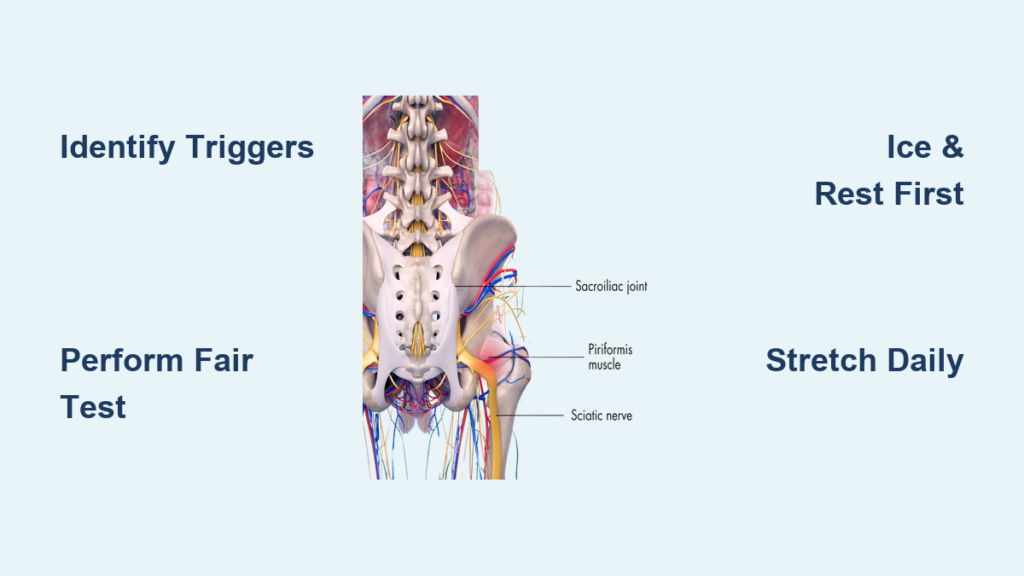
That persistent ache radiating from your lower back through your buttock and down your leg isn’t just ordinary muscle soreness. If you’ve tried standard back pain remedies with little success, you might be dealing with piriformis syndrome—a specific neuromuscular condition where your piriformis muscle compresses the sciatic nerve. Unlike general back pain that originates in your spine, this condition creates distinctive back and buttock muscle pain that requires targeted treatment. Understanding this difference is crucial because treating spinal issues won’t resolve muscle-related nerve compression in your buttock region.
Most people suffering from back and buttock muscle pain mistakenly attribute their symptoms to sciatica or a herniated disc. But with piriformis syndrome accounting for 0.3% to 6% of all lower back pain cases, it’s a surprisingly common yet frequently misdiagnosed condition. The good news is that most cases resolve within weeks when you apply the right strategies. This guide reveals exactly how to identify, treat, and prevent piriformis-related back and buttock muscle pain so you can return to pain-free movement.
Identify Your Piriformis Pain Triggers
Piriformis syndrome creates distinctive symptom patterns that differ from standard back pain. This small, pear-shaped muscle runs from your lower spine through your buttock to the top of your thigh, making it essential for nearly all lower body movements. When it spasms or swells, it compresses the sciatic nerve—your body’s longest nerve—which travels from your spinal cord through your buttocks down to your feet.
Activities that specifically worsen piriformis-related back and buttock muscle pain:
– Sitting for more than 20 minutes on hard surfaces
– Climbing stairs or hills
– Running or cycling
– Any motion involving hip rotation
– Direct pressure on your buttock area
Unlike spinal-related sciatica that typically originates in your lower back, piriformis syndrome creates more localized pain centered deep in your buttock. If your back and buttock muscle pain intensifies when sitting but improves when standing, piriformis involvement is likely. The key distinction matters because treatments targeting spinal issues won’t resolve this specific muscle compression problem.
Why Traditional Back Pain Treatments Fail for Piriformis Syndrome
Most back pain remedies focus on spinal alignment and disc health, but piriformis syndrome requires completely different intervention. Since the pain originates from muscle compression on the sciatic nerve at the buttock level rather than spinal issues, standard back pain approaches often worsen symptoms. Aggressive spinal manipulation or core strengthening without addressing piriformis tightness can increase nerve compression.
The anatomical variation where some people have the sciatic nerve passing through (rather than under) the piriformis muscle makes diagnosis even trickier. This explains why certain individuals experience severe back and buttock muscle pain from minor piriformis irritation while others remain symptom-free despite similar muscle tightness.
Perform These 3 Home Diagnostic Tests

While professional evaluation remains essential, these simple tests help determine if your back and buttock muscle pain stems from piriformis syndrome:
FAIR Test for Piriformis Compression
Lie on your unaffected side with knees slightly bent. Have someone gently move your painful leg backward, across your body, and turn your foot inward. If this reproduces your characteristic buttock pain, piriformis syndrome is likely the culprit. This test—named for Flexion, Adduction, and Internal Rotation—specifically stresses the piriformis muscle to reveal compression points.
Seated Figure-Four Assessment
Sit upright in a chair and cross your affected leg over the other, placing your ankle on the opposite knee. Gently press down on the crossed knee while maintaining an upright posture. Deep, localized pain in your buttock indicates piriformis involvement rather than general back pain. Be careful not to lean forward, as this shifts stress to your spine.
Trigger Point Palpation Technique
Locate the center of your buttock and press firmly with your thumb. If you find a tender, rope-like muscle band that reproduces your symptoms when pressed, you’ve likely identified the problematic piriformis trigger point. This spot typically sits halfway between your tailbone and the bony prominence of your hip.
Immediate Pain Relief Protocol (First 72 Hours)

When back and buttock muscle pain strikes, follow this targeted approach rather than generic back pain remedies:
Day 1-2 Acute Management
Apply ice packs directly to your buttock for 15-20 minutes every 2-3 hours during the first 48 hours to reduce inflammation around the sciatic nerve. Avoid heat initially, as it can increase swelling in the acute phase. Take over-the-counter NSAIDs like ibuprofen to combat muscle inflammation, but never exceed recommended doses.
Modify your sitting position immediately—use a cushion or pillow under your affected buttock to relieve pressure on the piriformis muscle. Set phone alarms to stand and walk for 2-3 minutes every 20-30 minutes of sitting. This prevents prolonged compression that worsens nerve irritation.
Day 3-7 Gentle Movement Phase
Begin the supine piriformis stretch: Lie on your back with knees bent, cross your affected leg over the opposite thigh, and gently pull the healthy thigh toward your chest. Hold for 30 seconds, repeating 3 times hourly while awake. This gentle traction creates space between the piriformis muscle and sciatic nerve.
Start short, frequent walks on flat surfaces—5 minutes every hour—to maintain circulation without aggravation. Avoid hills, stairs, or uneven terrain during this critical healing phase. Consider swimming or water walking as excellent low-impact alternatives that reduce pressure on the piriformis muscle.
Daily Stretching Routine for Permanent Relief
Perform these three targeted stretches 3 times daily, holding each for 30-45 seconds with slow, deep breathing:
Supine Piriformis Stretch
Lie flat on your back with knees bent and feet flat on the floor. Cross your affected ankle over the opposite knee, then grasp behind your healthy thigh and gently pull it toward your chest. You should feel a deep stretch in your buttock, not your lower back. Keep your head and shoulders relaxed on the floor throughout.
Seated Figure-Four Stretch
Sit upright in a firm chair with feet flat on the floor. Cross your affected ankle over the opposite knee, maintaining an upright posture. Gently hinge forward at your hips (not your waist) until you feel the stretch in your buttock. Never force this movement—pain indicates you’re pushing too far.
Standing Hip Flexor Stretch
Stand in a staggered stance with your affected leg behind you. Keep your torso upright and gently push your hips forward until you feel a stretch in the front of your hip. This indirectly relieves piriformis tension by balancing opposing muscle groups. Hold onto a wall for stability if needed.
Prevent Back and Buttock Muscle Pain Recurrence
Most piriformis syndrome cases resolve within weeks, but recurrence rates remain high without proper prevention strategies. Implement these lifestyle modifications immediately:
Workstation Adjustments That Actually Work
Position your computer screen at eye level to maintain neutral spinal alignment. Use a lumbar support cushion that maintains your natural lower back curve, not one that pushes you forward. Alternate between sitting and standing every 20 minutes—set a timer if needed. When driving, place a small rolled towel behind your lower back and adjust your seat to keep hips level with or slightly higher than knees.
Essential Exercises for Long-Term Relief
After acute pain subsides, incorporate these three exercises three times weekly:
1. Clamshells: Lie on your side with knees bent, feet together. Keeping feet touching, lift your top knee while maintaining hip alignment
2. Glute bridges: Lie on your back with knees bent, lift hips while squeezing glutes
3. Side leg raises: Lie on your side and lift your top leg straight up, keeping it in line with your body
When to Seek Professional Help
Contact your healthcare provider immediately if you experience progressive leg weakness, increasing numbness spreading down your leg, or frequent tripping due to pain. Also seek help if symptoms persist beyond 2-3 weeks of consistent home treatment—this indicates you may need specialized physical therapy or diagnostic injections.
For persistent cases, a physical therapist can provide manual therapy techniques to release piriformis trigger points and teach proper movement patterns. In rare cases where conservative treatment fails after 6 months, your doctor might recommend diagnostic injections or surgical options, though these are seldom necessary.
The key to eliminating back and buttock muscle pain permanently lies in recognizing that this isn’t ordinary back pain—it’s a specific muscle-nerve interaction requiring targeted treatment. By implementing these precise stretching techniques, modifying your sitting habits, and strengthening supporting muscles, you’ll not only resolve current symptoms but prevent future flare-ups. Start today with the immediate relief protocol, progress to the stretching routine, and commit to the prevention strategies that keep your piriformis muscle functioning properly for lasting relief.