
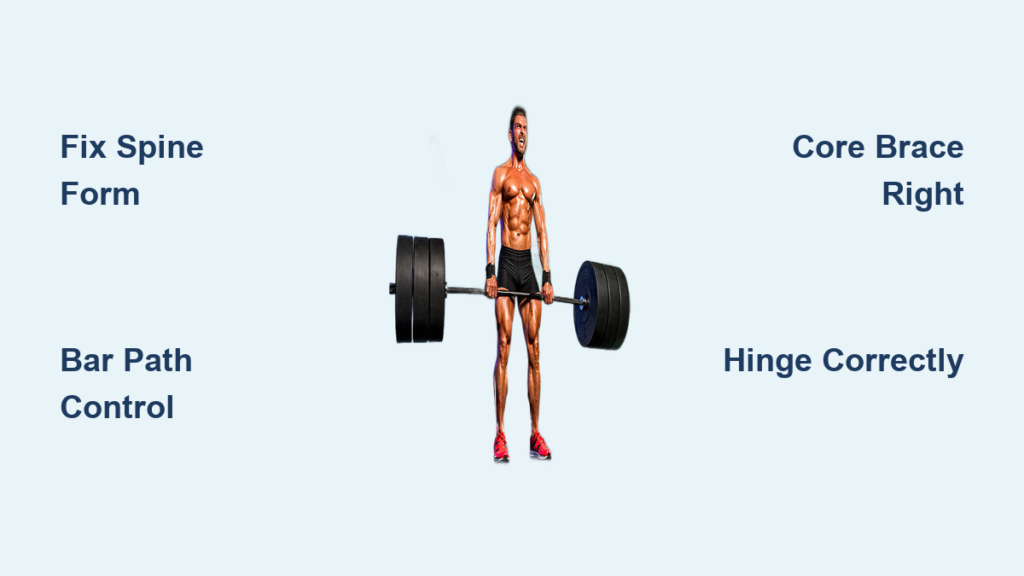
That sharp twinge when you bend to tie your shoes after deadlifts? Or the constant ache that makes sitting unbearable? You’re not failing as a lifter—your body is screaming for technical adjustments. Lower back pain from deadlifting affects 65% of regular lifters, but here’s the truth: it’s rarely the lift itself causing harm. It’s how you’re executing it. This guide cuts through gym myths with biomechanics-backed fixes to eliminate pain while building stronger pulls. You’ll learn to distinguish muscle soreness from dangerous injury, master pain-free hinge mechanics, and follow a 4-week return-to-lift protocol proven in sports clinics.
Deadlift Back Pain vs Normal Soreness
Your lower back pain from deadlifting could be harmless DOMS—or a ticking time bomb. Spot the difference before your next session:
| DOMS (Safe Soreness) | Injury Red Flag |
|---|---|
| Starts 24–72 hours post-lift | Hits during or immediately after lifting |
| Dull, symmetrical ache across lower back | Sharp, stabbing, or burning localized pain |
| Eases with walking or light stretching | Worsens when repeating hip hinge motion |
| No leg numbness or weakness | Tingling, foot drop, or radiating sciatica pain |
| Resolves within 3–4 days | Persists beyond 7 days or disrupts sleep |
Critical warning: Shooting leg pain, bladder issues, or night pain demand immediate medical evaluation—these signal nerve compression requiring urgent intervention.
Why Your Deadlifts Trigger Lower Back Pain

Rounded Spine Under Heavy Load
Letting your lumbar curve collapse multiplies disc shear forces by 300%. One sloppy rep at 315lbs causes more damage than ten perfect reps at 225lbs. The fix? Initiate the pull by pushing the floor away with your legs—not yanking the bar upward.
Early Hip Rise During Lift-Off
When hips shoot up before the bar clears your knees, your lower back becomes the primary mover. This happens if you start with hips too low. Reset with shins 1–2 inches from the bar and drive through mid-foot—not toes—to keep hips and shoulders rising together.
Bar Drifting Forward Off Your Shins
Every inch the bar moves in front of your mid-foot increases lumbar torque. Film your side profile: the bar must zip up your body from floor to lockout. If it drifts, your hips are too high at setup or you’re pulling with arms instead of legs.
Over-Extending at Lockout
Thrusting hips forward violently jams facet joints. Stand tall with glutes squeezed—but keep ribs down and core braced. Imagine holding a sheet of paper between your pelvis and ribs; if it falls, you’re overextending.
Failed Core Bracing Strategy
Inhaling without 360° abdominal expansion leaves your spine unprotected. Practice lying on your back: press lower back into floor while breathing deeply into sides/abdomen. You should feel rock-solid stiffness—that’s the brace needed under load.
Immediate Pain Relief Protocol
First 72 Hours: Damage Control
- Stop all lifting immediately—no “testing it out”
- Ice for 15 minutes every 2 hours to reduce inflammation
- Walk 5 minutes every hour to maintain blood flow
- Sleep with pillow under knees (on back) or between thighs (on side)
- Avoid NSAIDs for first 48 hours—they can delay tissue healing
Days 3–14: Restore Movement
- Switch to moist heat packs 20 minutes twice daily
- Perform cat-camel stretches every hour: arch spine upward while exhaling, then dip belly while inhaling
- Master dead bugs: Lie on back, lower opposite arm/leg toward floor while keeping lower back pressed down (3 sets of 10)
- Return-to-lift test: Pain-free bodyweight hip hinge with neutral spine = green light to progress
Rehab Exercises That Target Pain Sources

| Exercise | Fixes | Sets × Reps |
|---|---|---|
| Bird Dog | Spinal instability | 3 × 8/side |
| Glute Bridge | Weak hip drive | 3 × 20 |
| Side Plank | Lateral core weakness | 3 × 30 sec |
| Hip Flexor Stretch | Anterior pelvic tilt | 3 × 30 sec/side |
| Hamstring Rockers | Hip hinge restriction | 3 × 10 |
Progress by adding resistance only when you complete all reps with perfect form. Start with bodyweight bridges before attempting kettlebell RDLs.
Perfect Your Deadlift Form in 60 Seconds
Setup Checklist
- Feet: Hip-width apart, shins 1–2″ from bar
- Grip: Just outside legs—shoulder blades in “back pockets”
- Spine: Chest proud, ribs down, flat lower back
- Brace: Inhale deeply into belly, squeeze glutes/core like catching a punch
- Bar Path: Must touch shins throughout lift
Execution Cues That Prevent Injury
- Lift-off: Push floor away (like leg press)—not pull bar up
- Mid-shin: Keep bar glued to thighs as hips rise
- Lockout: Squeeze glutes hard while pulling shoulders back
- Descent: Hinge hips first—bar slides down thighs in reverse motion
Pro tip: Film every set. If the bar moves more than 1cm horizontally from side view, reset your setup.
Prevent Pain With Smarter Programming
Warm-Up That Works (5 Minutes)
- 2-minute brisk walk
- Leg swings: 10 forward/backward, 10 side-to-side
- Cat-camel: 10 reps
- Glute bridge: 15 reps
- Bodyweight good-morning: 15 reps
Load Progression Rules
- Add ≤5lbs per week for lifts under 225lbs
- Cap heavy deadlift reps at 10 total per session
- Deload every 4th week—drop volume by 20%
- Master 3 sets of 8–10 reps at RPE 6–7 before increasing weight
Essential Accessory Circuit (2x/week)
- Hip thrusts: 4 × 8
- Single-leg RDL: 3 × 10/side
- Pallof press: 3 × 15/side
- Farmer carries: 3 × 30 meters
4-Week Return-to-Lift Plan
| Week | Exercise | Load | Sets × Reps |
|---|---|---|---|
| 1 | Kettlebell RDL | 30% 1RM | 3 × 12 |
| 2 | Trap-bar from blocks | 40% 1RM | 4 × 8 |
| 3 | Conventional deadlift | 50% 1RM | 5 × 5 |
| 4 | Conventional deadlift | 60% 1RM | 4 × 6 |
Progress only if: Zero pain during lifts AND 24 hours post-session AND vertical bar path on video review.
Long-Term Back Protection Strategy
- Video form checks every 4 weeks at 70% 1RM
- Track HRV: Drop intensity if morning readings fall >10% for 3 days
- Prioritize recovery: 8 hours sleep, 1.8g/kg protein, 5g creatine daily
- Quarterly mobility screens: Test hip hinge depth and ankle dorsiflexion
When to See a Specialist
| Symptom | Action Required |
|---|---|
| Pain lasting >10 days | Sports medicine physician |
| Leg numbness or foot drop | Immediate orthopedic consult |
| Positive slump test <45° | MRI to rule out disc herniation |
| Failed 6-week rehab | Spinal specialist referral |
Bottom line: Lower back pain from deadlifting isn’t inevitable—it’s a form feedback signal. Respect the pain by fixing your hinge mechanics before chasing heavier weights. Master the 60% load with perfect bar path, and you’ll build a resilient posterior chain that lifts pain-free for decades. Your strongest deadlifts are built on flawless technique, not willpower through injury.