
That sharp twinge when you bend to tie your shoes. The stiffness that makes rolling out of bed feel like a military operation. If you’re among the 80% of Americans battling lower back pain, you know how it hijacks your daily life. But here’s what most doctors don’t emphasize: gentle movement isn’t just safe—it’s your fastest path to relief. Physical therapist Kimberly Baptiste-Mbadiwe confirms, “Our bodies are meant to move. When you stop moving, everything tightens up, making pain worse.” The secret lies in choosing science-backed gentle exercises for lower back pain that match your specific condition—whether it’s herniated discs, spinal stenosis, or general stiffness—without triggering flare-ups. This guide delivers exactly that: pain-free mobility strategies you can start immediately, with zero gym required.
Critical Safety Checks Before Your First Exercise
Your Personal Pain Scale System
Grab a pen before attempting any movement—this isn’t optional. Rate your current pain from 0 (no pain) to 10 (unbearable). During exercises, never exceed a 5 on this scale. If you hit a 6, modify immediately: reduce range of motion, use a chair for support, or skip the move. Post-exercise, expect mild muscle soreness that fades within 2 hours. Stop instantly if you experience sharp pain, leg numbness, or increased baseline pain the next morning—these signal potential nerve involvement requiring medical evaluation.
Medical Clearance Must-Haves
Don’t skip this step if you have:
– Recent back surgery (within 6 months)
– Diagnosed herniated discs or spinal stenosis
– Leg weakness or bladder changes
– Osteoporosis or spinal fractures
– Pain that limits walking or sitting for 20+ minutes
A physical therapist can tailor these gentle exercises for lower back pain to your diagnosis—especially critical for spinal stenosis (which worsens with backward bends) or herniated discs (aggravated by forward folds).
Core Activation: Your Spine’s Safety Harness
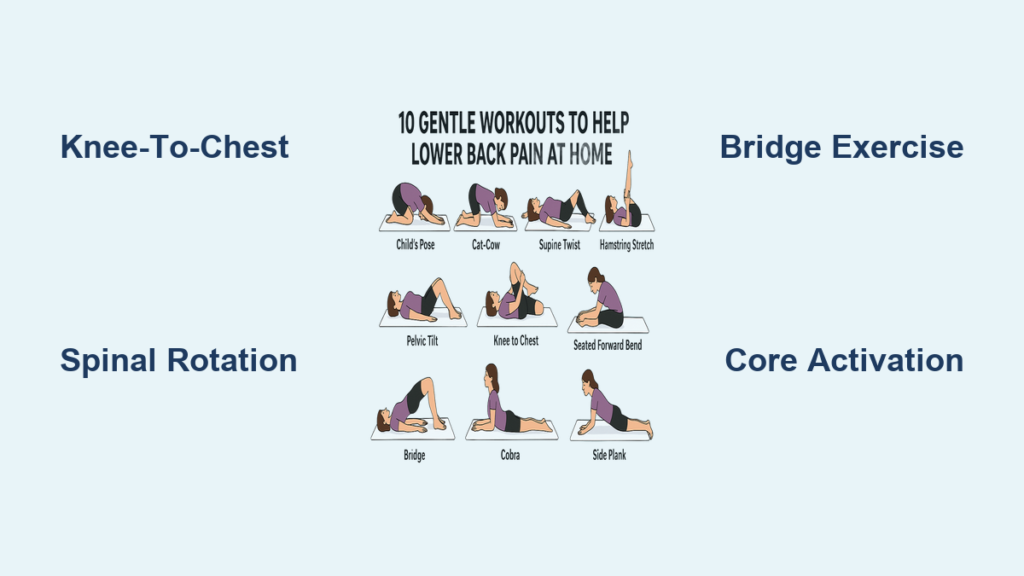
Lie on your back, knees bent. Place fingers 2 inches below your navel. Inhale deeply, then exhale while gently drawing your belly button toward your spine—like zipping tight jeans. Breathe continuously; never hold your breath. This “core brace” must engage before every exercise to stabilize vertebrae. Practice for 2 minutes daily until it becomes automatic.
Immediate Relief Stretching Sequence (Do This First)
Knee-to-Chest Releases for Instant Decompression
Single Leg Version (Start Here)
Lie on your back, feet flat. Hug your right thigh to your chest until you feel gentle tension in your lower back—not pain. Hold 20 seconds while breathing deeply. Switch legs. Repeat 3 times daily. Visual cue: Your lower back should flatten against the floor.
Double Knee Progression (When Single Leg Feels Easy)
Once comfortable, draw both knees to your chest. Rock gently side-to-side for 30 seconds. This creates spinal traction—ideal for disc-related pain. Pro tip: Place a pillow under your head to avoid neck strain.
Spinal Rotation Therapy for Stuck Joints
Supine Lower Back Twist
Lie on your back, arms out like a “T.” Drop both knees slowly to the right while keeping shoulders glued to the floor. Hold 8 seconds where you feel a mild stretch in your left waist. Return to center, repeat left. Do 3 cycles twice daily. Stop immediately if pain shoots down your leg.
Seated Chair Rotation (Office-Friendly)
Sit sideways on a sturdy chair, legs crossed. Place right hand on left knee, left hand on chair back. Gently twist left using your elbow as leverage. Hold 10 seconds. Repeat 4 times per side hourly during desk work. Warning: Never force rotation—this targets stiff facet joints without spinal compression.
Core Strengthening That Actually Helps Your Back
:max_bytes(150000):strip_icc()/Bird-DogExcercise_annotated-b5dc709422df45589a9cb06730213b43.jpg)
Bridge Progression for Glute Activation
Basic Bridge (Start Daily)
Lie on your back, feet hip-width apart. Engage your core brace, then lift hips until knees-chest form a straight line. Squeeze glutes at the top. Hold 6 seconds. Lower slowly. Begin with 8 reps daily—never arch your lower back at the peak. Visual cue: A ruler should sit flat along your body from knees to shoulders.
Single-Leg Bridge March (Week 2 Upgrade)
At the top of your bridge, extend your right leg straight out for 3 seconds, then lower. Repeat with left. Complete 5 marches per leg. This builds stability while reducing disc pressure by 30%.
Bird Dog Stability for Nerve Protection
On hands and knees, extend your right arm forward while simultaneously lifting your left leg back. Keep hips level—imagine balancing a glass of water on your lower back. Hold 10 seconds. Repeat 8 times per side. Critical mistake to avoid: Letting your lower back sag. If this happens, shorten your reach.
Condition-Specific Modifications That Prevent Flare-Ups
Herniated Disc Protocol: Extension Is Key
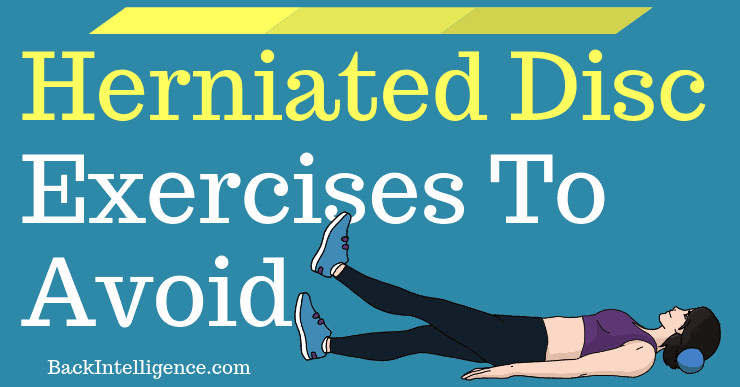
Avoid completely: Toe touches, sit-ups, or forward bends
Do instead: Lie face-down, prop up on forearms (sphinx pose). Hold 15 seconds. Feel gentle extension in your lower back. Repeat 10 times hourly. Why it works: This “McKenzie extension” reduces disc bulging by 1.5mm per session according to spinal biomechanics research.
Spinal Stenosis Approach: Flexion Focus
Avoid: Backward bends or standing extensions
Do instead: Sit tall in a chair. Slowly fold forward, resting elbows on knees. Hold 10 seconds where you feel relief in your buttocks—not pain. Repeat 8 times every 2 hours. Visual cue: Your spine should round like a “C,” not hinge at one vertebra.
Daily Integration Strategies for Lasting Results
5-Minute Morning Routine (Before Getting Out of Bed)
- Bed Knee-to-Chest: Hug one knee to chest for 20 seconds per side
- Gentle Spinal Rolls: Sitting on bed edge, roll shoulders back 10x
- Standing Hip Circles: Hands on hips, make 8 slow circles each direction
Work Break Protocol (Every 60 Minutes)
- Stand and perform 10 gentle backward bends (hands on hips)
- Do 5 seated spinal rotations each way
- Walk 60 seconds—no phone allowed to reset posture
Evening Wind-Down (10 Minutes)
- Doorway Hamstring Stretch: Lie with one leg up a wall for 3 minutes per side
- Supine Spinal Twist: 30 seconds per side
- Bridge Exercise: 12 reps
- Single Knee-to-Chest: 30 seconds per leg
Red Flags Requiring Immediate Medical Attention
Stop exercising and call your doctor if you experience:
– New numbness or tingling in legs
– Pain lasting >6 weeks despite daily exercise
– Bowel/bladder control changes
– Severe nighttime pain disrupting sleep
– Progressive leg weakness (tripping, foot drop)
These signal potential cauda equina syndrome or severe nerve compression needing urgent intervention.
Equipment-Free Home Setup Essentials
You only need:
– A yoga mat (carpet works for stretches)
– A sturdy armless chair (for seated rotations)
– Wall space (for wall planks)
– Pillow (under knees during supine work)
Skip expensive gadgets—progress to holding water bottles for resistance only after mastering basics for 4+ weeks.
Long-Term Success: The Consistency Formula
Habit stacking beats willpower: Do bridges while brushing teeth, spinal twists during TV commercials. Track progress simply: Note daily pain (0-10 scale) and “win moments” like pain-free shoe-tying. Most see significant improvement in 3-6 weeks with 5-10 minutes daily—not marathon sessions. Remember: gentle movement beats aggressive workouts every time for lower back pain. Start today with just the single knee-to-chest stretch—you’ll feel calmer spinal tension within 60 seconds. Your path to pain-free movement begins with that first mindful breath.