
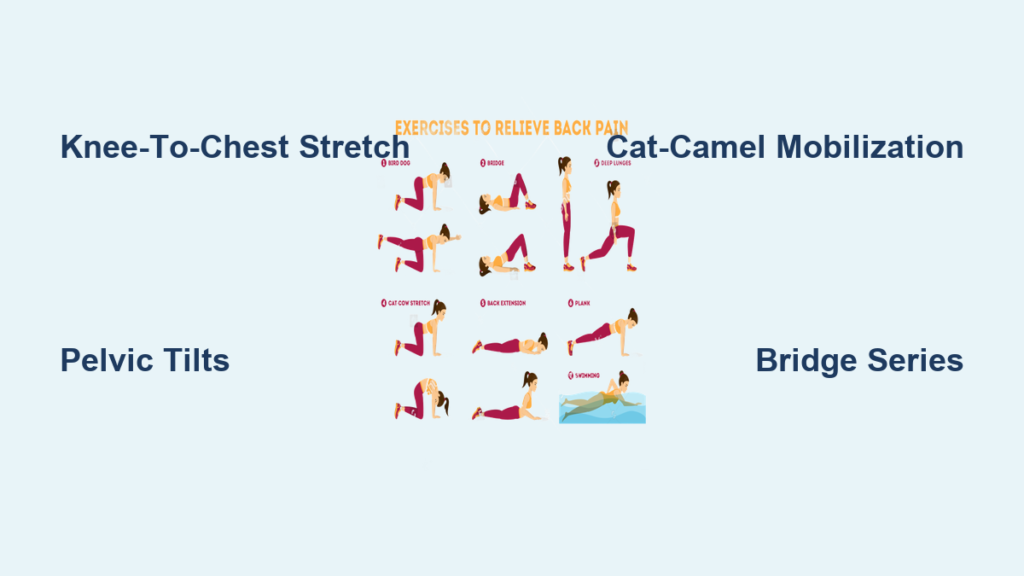
Eight out of ten Americans will battle back pain this year—more prevalent than the common cold and responsible for 10% of global disability cases. Whether you’re wincing after lifting groceries or stiff from marathon Zoom calls, you’re not alone. The good news? Strategic movement beats bed rest every time. This guide delivers the exact exercises physical therapists prescribe, organized by when they work and how to progress safely. You’ll discover exercises to relieve back pain that target your specific triggers while avoiding dangerous missteps.
Most flare-ups stem from strained muscles or protective spasms—not structural damage. Gentle, targeted exercises to relieve back pain pump nutrients into spinal discs, relax angry muscles, and retrain your nervous system to trust movement again. Research confirms consistent activity cuts recovery time in half compared to immobilization. Before starting, rate your discomfort 0-10. During these exercises to relieve back pain, keep pain below 5/10. Post-workout soreness should feel like “good burn” and vanish within 30 minutes. If tomorrow’s pain spikes higher, scale back immediately.
Why Your Spine Craves These Specific Exercises
Back pain rarely means your spine is broken. Over 90% of cases involve muscle strains, compressed discs, or protective guarding—not fractures or severe nerve damage. When you move strategically, you reverse the cycle of stiffness and inflammation. These exercises to relieve back pain work because they:
- Hydrate spinal discs through rhythmic compression (like cat-camel mobilizations)
- Release referred tension from tight glutes or hamstrings that mimic back pain
- Activate deep stabilizers (transverse abdominis and multifidus) that act as your natural back brace
- Reset pain signals by proving movement is safe to your nervous system
Crucially, avoid the “no pain, no gain” myth. Pain above 5/10 during exercise indicates tissue irritation. If your discomfort worsens the next morning, you’ve overdone it—scale back reps or range immediately. Consistency with gentle movement trumps intensity every time.
Non-Negotiable Safety Rules Before You Begin
Skipping these steps risks turning minor strain into chronic pain. Follow these rules strictly:
- Get medical clearance first if you have diagnosed spinal conditions, recent surgery, or pain radiating below the knee
- Start microscopic: Begin with 2-3 reps or 5-second holds maximum—no heroics
- Progress by time, not reps: Add 1-2 repetitions only every 3-4 days when pain stays stable
- Split routines: Stretch 2-3x daily but strengthen core muscles only 2-3x weekly (never consecutive days)
- Warm up religiously: Always march in place or rotate your trunk gently for 2 minutes before stretching
Critical visual cue: During supine exercises, check if your lower back naturally arches off the floor. If yes, you’re engaging superficial muscles instead of deep stabilizers—flatten that gap by drawing your navel toward your spine.
Immediate Relief Stretches for Acute Pain
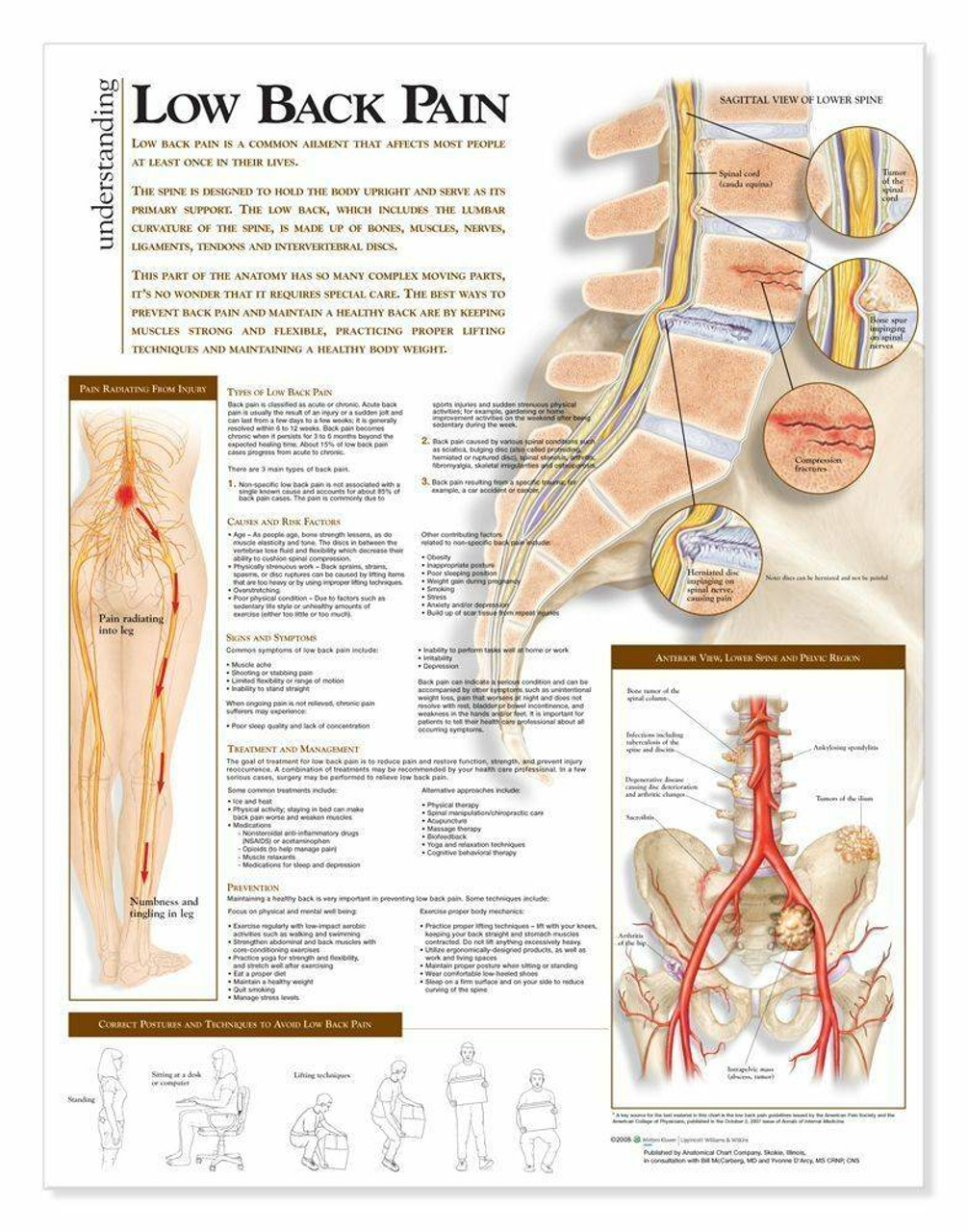
Perform these whenever stiffness strikes or pain spikes. They decompress joints and release muscle tension within minutes.
Knee-to-Chest Release for Lumbar Spasm
Lie on your back with knees bent and feet flat. Grasp one thigh and pull your knee toward your chest, keeping the opposite foot relaxed on the floor. Hold 20-30 seconds while breathing deeply into your ribs—not your belly. Repeat 2-3 times per side, 2-3 times daily. For severe tightness, pull both knees simultaneously toward your chest.
Pro tip: Place a pillow under your head if neck strain occurs. Stop immediately if you feel sharp nerve pain—this stretch isn’t for herniated discs with radiating symptoms.
Lower-Back Rotations for Stiff Morning Pain
Lie on your back with knees bent and arms out in a “T.” Gently roll both knees to one side like a windshield wiper while keeping shoulders glued to the floor. Hold 5-10 seconds where you feel gentle tension (not pain), then return to center. Repeat 10-20 times per side. This mobilizes individual spinal segments often frozen from sitting.
Red flag: If this causes electric shooting pain down your leg, skip it—your discs may be irritated.
Cat-Camel Mobilization for Disc Hydration
Position yourself on hands and knees with wrists under shoulders and knees under hips. Exhale while arching your back upward like an angry cat (tucking chin to chest). Inhale while dropping your belly toward the floor and lifting head/tailbone (camel position). Move slowly through 10-20 cycles, focusing on fluid motion.
Expert note: This pumps nutrient-rich fluid into dehydrated discs—the leading cause of degenerative pain. Never force extreme ranges; quality beats amplitude.
Figure-Four Glute Stretch for Sciatica Relief
Lie on your back and cross your right ankle over your left knee. Pull your left thigh gently toward your chest until you feel deep tension in your right glute (not your knee). Hold 30 seconds, breathing steadily. Repeat 2-3 times per side. Targets the piriformis muscle—a frequent sciatica trigger.
Modification: Perform seated in a chair if floor positioning hurts. Keep your spine neutral; don’t round your back.
Core Stability Essentials to Prevent Recurrence
Weak deep core muscles force superficial back muscles to overwork, creating vicious pain cycles. These rebuild your body’s natural back brace.
Pelvic Tilt Activation for Deep Core Engagement
Lie on your back with knees bent. Draw your navel toward your spine while gently flattening your lower back into the floor—imagine zipping a tight pair of jeans. Hold 5-10 seconds while breathing normally. Start with 10 reps, progressing to 20 as strength improves.
Progression: Perform this while standing in line or seated at your desk. The key is maintaining this “braced” position during daily lifts.
Bridge Series for Glute Power
From the pelvic tilt position, squeeze your glutes and lift your hips until your body forms a straight line from knees to shoulders. Hold 5 seconds, lowering slowly. Begin with 10 reps, progressing to 15-20.
Form check: Place a hand under your lower back—if you can slide it easily under your arch, you’re overextending. The lift must come from glutes, not lumbar muscles.
Bird-Dog Balance for Spinal Control
On hands and knees, extend your right arm forward and left leg back simultaneously until parallel with the floor. Hold 5 seconds without wobbling. Return slowly and switch sides. Master 10 reps per side before adding movement.
Critical mistake: Looking up strains your neck—keep your gaze at the mat. If you feel lower back arching, reduce your range.
Condition-Specific Modifications for Faster Healing

Match your routine to your specific issue using these medical-grade adjustments:
Herniated Disc Protocol
- Do immediately: Prone press-ups (lying on stomach, propping up on elbows to gently extend spine) and standing back bends
- Avoid: Forward bends, sit-ups, or toe touches that increase disc pressure
- Why: Extension movements centralize pain by pushing disc material away from nerves
Spinal Stenosis Strategy
- Do immediately: Seated forward bends (hinging at hips with back straight) and knee-to-chest releases
- Limit: Prolonged standing or extension movements that narrow spinal canals
- Why: Flexion opens compressed nerve spaces in stenosis
Spondylolisthesis Approach
- Focus: Core bracing during all movements and hip strengthening (clamshells)
- Skip: Hyperextension or loaded backbends that worsen slippage
- Why: Stability prevents further vertebral displacement
Your 15-Minute Daily Pain Relief Routine
Consistency trumps intensity. This micro-routine fits any schedule:
- Minutes 0-2: Warm-up with standing trunk rotations (10 reps each direction)
- Minutes 2-7: Knee-to-chest (30s x 2), lower-trunk rotations (10x each side), figure-four stretch (30s x 2)
- Minutes 7-12: Pelvic tilts (15 reps), bridges (15 reps), bird-dog (10 reps per side)
- Minutes 12-15: Cat-camel cool-down (10 slow cycles) with diaphragmatic breathing
Progression: After 2 weeks, add light resistance bands to bridges or hold pelvic tilts 2 seconds longer. Never add intensity if pain increases.
Recovery Accelerators Between Sessions
Maximize healing with these science-backed tactics:
– Heat therapy: 15-minute warm shower before stretching to relax tight muscles
– Cold therapy: 10-minute ice pack after strengthening to calm inflammation
– Walking: 10-20 minutes daily maintains disc nutrition better than supplements
– Sleep setup: Side-sleepers place pillow between knees; back-sleepers under knees
Critical prevention tip: Set phone alarms for hourly micro-breaks during desk work. Stand and perform 2 cat-camel cycles to reset spinal loading.
Warning Signs to Stop Immediately
Seek urgent care if you experience:
– Numbness or tingling spreading down legs (especially past knees)
– Foot drop or weakness causing stumbling
– Night pain that worsens when lying flat
– Bowel/bladder control changes
These indicate nerve compression requiring medical intervention—not exercise.
Your First 7-Day Action Plan
Start today with just two moves: knee-to-chest stretches upon waking and pelvic tilts before bed. Track your pain score (0-10) before and after each session. Most people see improvement within 7-10 days of consistent practice. If symptoms plateau after four weeks, consult a physical therapist for personalized progression.
Remember: Your spine thrives on movement variety, not perfection. Pair these exercises to relieve back pain with walking or swimming for lifelong resilience. In just minutes daily, you’ll transform from stiff and fearful to moving freely—proving that the best medicine for back pain is motion done right.