
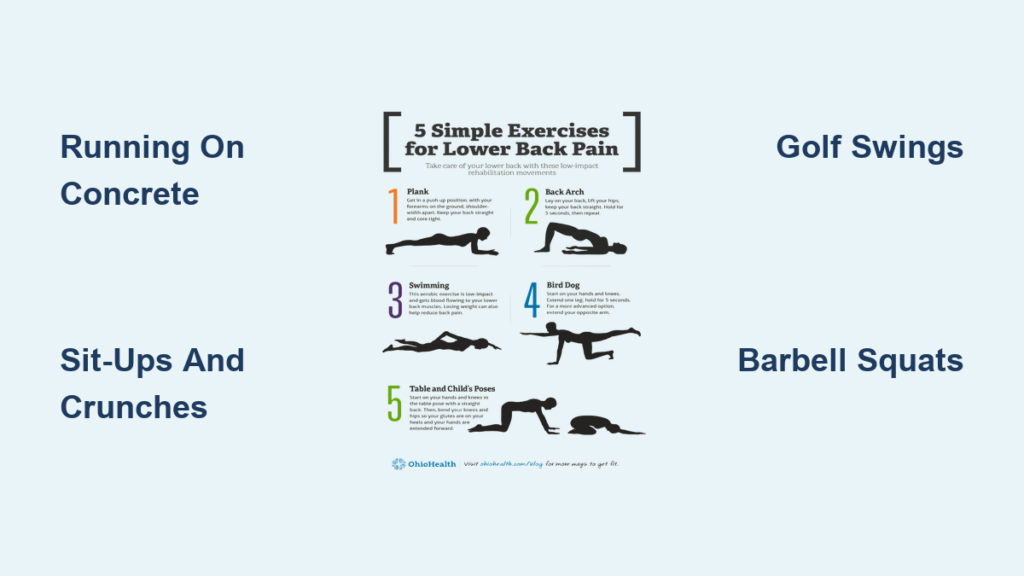
That sharp twinge during your morning workout. The familiar ache that flares when you bend to tie your shoes. If you’re among the 80% of Americans who’ve battled lower back pain, you know how quickly the wrong movement can turn manageable discomfort into debilitating agony. Most people don’t realize that certain gym staples—moves they’ve done for years—are silently sabotaging their spinal recovery. The truth? Exercises not to do with lower back pain are often the very ones we default to when trying to “strengthen” our backs. This isn’t about avoiding movement—it’s about dodging specific spine-damaging actions that accelerate disc degeneration and inflame sensitive nerves. You’ll discover exactly which exercises to eliminate today, why they’re dangerous, and how to replace them with moves that actually heal.
Running and Jumping: The Concrete Spine Crusher
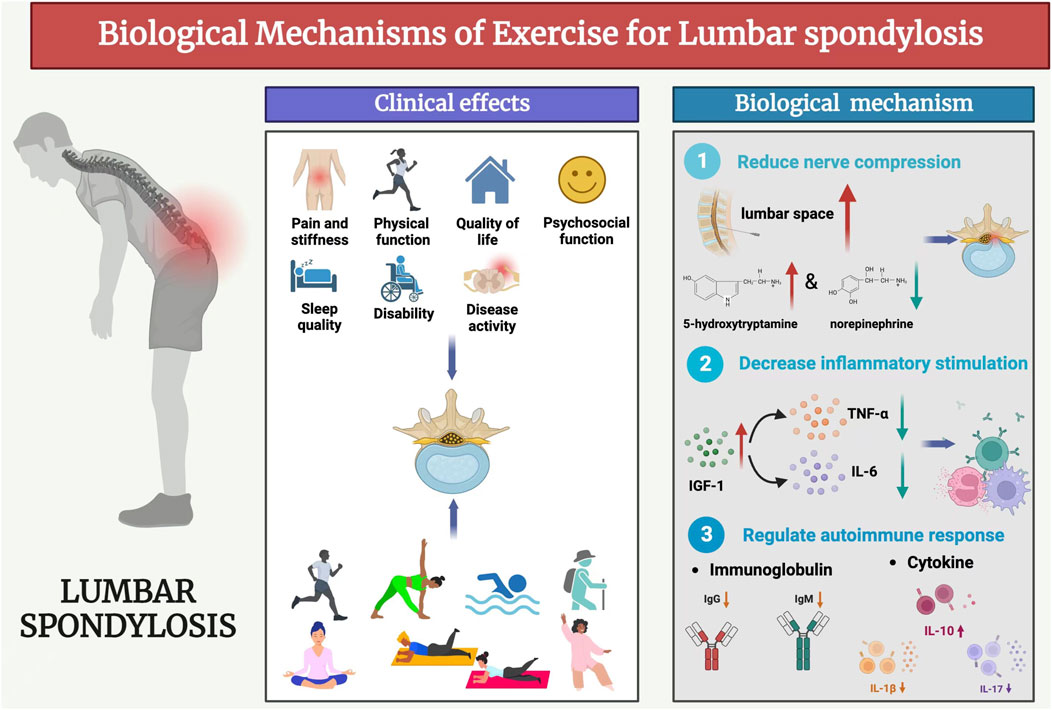
Every footstrike during pavement running sends shockwaves through your lumbar discs at forces up to 2.5x your body weight. When your back’s already irritated, this repetitive compression acts like a hydraulic press on vulnerable spinal structures. Hard surfaces like asphalt or gym floors magnify the damage exponentially, especially during downhill runs where braking forces spike disc pressure.
Immediate red flags during impact activities:
– Pain intensifies with each stride (not just initial discomfort)
– Localized tenderness over lumbar vertebrae after activity
– Increased stiffness the morning after exercise
Stop these high-risk moves now:
– Running on concrete, asphalt, or downhill slopes
– Jumping jacks in HIIT circuits
– Box jumps or depth jumps from platforms
– Medicine ball slams with rotational force
Try these spine-friendly swaps:
– Water walking in chest-deep pool (reduces impact by 90%)
– Recumbent cycling with lumbar support pad
– Elliptical trainer set to low resistance
– Flat-terrain walking with posture checks every 5 minutes
Sit-Ups and Crunches: The Disc-Squishing Trap
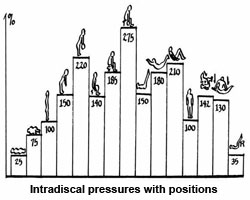
Traditional crunches create 140% more pressure on spinal discs than standing upright—like slowly squeezing toothpaste from the middle of the tube. This repeated flexion forces disc material backward, worsening bulges or herniations that pinch nerves. Adding hand-behind-head tension compounds cervical strain, creating a double whammy for spinal health.
Critical danger signs during core work:
– Sharp pain at the base of your spine during curl-up
– Numbness radiating down legs after exercise
– Inability to maintain neutral spine in plank position
Eliminate these lumbar-damaging moves:
– Full sit-ups with straight legs
– Bicycle crunches with torso rotation
– Double-leg raises (both legs lifted simultaneously)
– Standing toe touches with knees locked
Build resilient core strength safely with:
– Dead bug variations: Lie supine, alternate extending opposite arm/leg while pressing lower back into floor
– Bird-dog holds: On hands/knees, extend right arm/left leg for 10-second holds (8 reps/side)
– Partial crunches: Lift shoulders only 2-3 inches off floor, elbows wide
– Single-leg glute bridges: One foot flat, lift hips while squeezing glutes
Golf Swings and Tennis Serves: The Nerve-Pinching Twists
A full golf swing generates rotational forces that narrow the nerve exit spaces in your spine by up to 30%. When combined with the weight shift and impact of a tennis serve, this creates a perfect storm for facet joint inflammation and disc shear. The real danger? These sports combine rotation with flexion—compressing one side of the disc while stretching the other.
Warning signs during rotational sports:
– Electric shooting pain down one leg during follow-through
– Loss of balance when rotating torso
– Clicking or grinding in lumbar spine during twists
Immediately stop these high-risk motions:
– Full golf swings with weight transfer
– Tennis serves with trunk rotation
– Kettlebell Russian twists (weighted seated rotation)
– Medicine ball woodchoppers with rotation
Maintain mobility safely with:
– Seated spinal rotations: Cross one ankle over opposite knee, gently rotate torso toward bent knee
– Standing side bends: Place hand on wall for support, lean laterally without twisting
– Cat-cow stretches: On hands/knees, alternate arching and rounding back (no rotation)
– Tai chi “wave hands”: Slow torso turns within pain-free range
Barbell Back Squats and Overhead Presses: The Shear Force Danger

When lumbar curve collapses during heavy squats, spinal shear forces spike by 200%. Overhead pressing creates posterior shear that grinds facet joints together—especially when rib cage flares and pelvis tucks under. These movements become landmines when fatigue compromises form, often causing immediate injury.
Critical form breakdowns to watch for:
– Butt wink: Pelvis tucking under at bottom of squat
– Bar drift: Weight shifting forward of mid-foot during lift
– Rib flare: Chest lifting excessively during overhead press
– Breath holding: Valsalva maneuver without core bracing
Avoid these spine-threatening lifts:
– Barbell back squats with lumbar rounding
– Overhead military presses with rib flare
– Bent-over rows with unsupported torso
– Conventional deadlifts beyond bodyweight
Build strength safely with:
– Goblet squats: Hold dumbbell vertically at chest, elbows inside knees
– Seated cable rows: Chest against pad, pull handle to lower ribs
– Front-foot elevated lunges: Back foot on bench, drive through front heel
– Supported overhead press: Sit against wall, press light dumbbells
Superman Extensions and Double-Leg Raises: The Hidden Spine Killers
Superman extensions generate the highest recorded lumbar joint loads in EMG studies—more than double standard deadlifts. Double-leg raises create dangerous shear forces by lifting both legs while supine, straining the iliopsoas attachment points on lumbar vertebrae.
Stop these “rehab” exercises immediately:
– Prone superman extensions (arms/legs lifted simultaneously)
– Straight-leg raises beyond 12 inches off floor
– Scissor kicks with both legs
– Back extensions on Roman chair
Safer alternatives that actually heal:
– Towel hamstring stretches: Supine, loop towel around foot, gently straighten knee
– Knee-to-chest pulls: Single leg only, keep opposite foot flat on floor
– Pelvic tilts: Lie knees bent, flatten lower back into floor for 5-second holds
– Quadruped rocking: On hands/knees, gently shift weight backward
Prolonged Sitting and Stomach Sleeping: The Daily Saboteurs
Sitting for more than 30 minutes without movement creates sustained disc pressure equivalent to lifting 40% of your body weight. Sleeping prone forces unnatural lumbar extension while twisting the neck 90 degrees—both degrading spinal structures over time.
Correct these daily movement errors:
– Sit with lumbar roll: Place small pillow in lower back curve
– Take micro-breaks: Stand/walk 2 minutes every 25 minutes
– Sleep on side: Place pillow between knees to align hips
– Lift with hip hinge: Bend knees/hips first, never waist
When to Stop All Exercise Immediately
Seek emergency care if you experience:
– Shooting leg pain below the knee (especially with coughing/sneezing)
– Numbness in saddle area (inner thighs, genitals, anus)
– Foot drop (tripping when walking)
– Uncontrollable bladder/bowel function
Pause all exercise and consult a spine specialist if:
– Pain worsens after 2 weeks of modified activity
– Night pain disrupts sleep consistently
– Weakness affects daily tasks (e.g., rising from chair)
– Pain exceeds 5/10 on intensity scale during movement
| Danger Move | Why It Wrecks Your Back | Spine-Safe Swap |
|---|---|---|
| Running on concrete | 2.5x body weight impact forces | Water walking in chest-deep pool |
| Sit-ups/crunches | 140% increased disc pressure | Dead bug with neutral spine |
| Golf swings | Nerve space narrowing + disc shear | Seated spinal rotations |
| Barbell back squats | Shear forces during lumbar rounding | Goblet squats with vertical torso |
| Superman extensions | Highest recorded lumbar joint load | Single-leg glute bridges |
| Stomach sleeping | Lumbar hyperextension + neck twist | Side sleeping with pillow between knees |
Building Back Resilience Without Risk
Your path to pain-free movement starts with respecting your spine’s current capacity. Never push through pain that lasts more than 15 minutes after exercise—this isn’t weakness, it’s biological data signaling tissue stress. Begin with 5 minutes of daily movement in safe ranges, gradually adding duration before intensity. Track your tolerance using the “2-hour pain rule”: if discomfort increases significantly within 2 hours post-exercise, you’ve exceeded your current threshold.
Focus on three non-negotiables: maintain neutral spine alignment (imagine a straight line from ribs to pelvis), breathe steadily during exertion (never hold breath), and prioritize control over speed. When in doubt, choose the modification—your back heals through consistent, intelligent movement, not heroics. If pain persists beyond 2 weeks of smart exercise modifications, consult a physical therapist specializing in spinal rehabilitation. Your strongest back isn’t built through punishing workouts, but through strategic movement that respects your body’s current limits.