
That nagging ache between your shoulder blades strikes when you least expect it—during a deep breath, while reaching for a high shelf, or even when simply sitting at your desk. Mid back pain affects nearly 20% of adults, derailing productivity and disrupting sleep for millions who struggle with thoracic spine discomfort daily. The good news? Most cases respond dramatically to targeted mid back pain therapy when you implement the right strategies.
Unlike neck or lower back pain, thoracic spine issues often get overlooked despite causing significant work absences averaging 3-7 days per episode. This guide delivers evidence-based mid back pain therapy protocols used by physical therapists, helping you identify your specific pain source and apply the most effective treatments for rapid relief and long-term recovery.
Pinpoint Your Exact Mid Back Pain Cause in 5 Minutes
Mechanical vs. Structural Pain Triggers
Your mid back pain likely stems from one of three distinct categories. Mechanical causes dominate 70% of cases—forward head posture from laptop use, rounded shoulders from phone scrolling, or improper lifting that twists your T6-T8 vertebrae. These respond exceptionally well to posture correction and specific exercises.
Structural pathologies account for 20% of cases, including compression fractures at T6-T8 vertebrae, degenerative disc disease, or Scheuermann’s disease in younger patients. These require precise diagnosis and modified exercise approaches.
Systemic conditions make up the remaining 10%, such as rheumatoid arthritis affecting costovertebral joints, fibromyalgia creating tender points, or GERD mimicking T6-T10 dermatome pain patterns. Recognizing these helps avoid misdirected treatment.
Critical Red Flags Needing Immediate Medical Attention
Seek urgent care if you experience progressive numbness, bowel/bladder dysfunction, fever with severe pain, unexplained weight loss, or pain after significant trauma. These symptoms require immediate imaging to rule out serious conditions like spinal infections or fractures.
Apply These 3 Immediate Mid Back Pain Relief Techniques

First 72 Hours: Stop Pain Cycle Before It Worsens
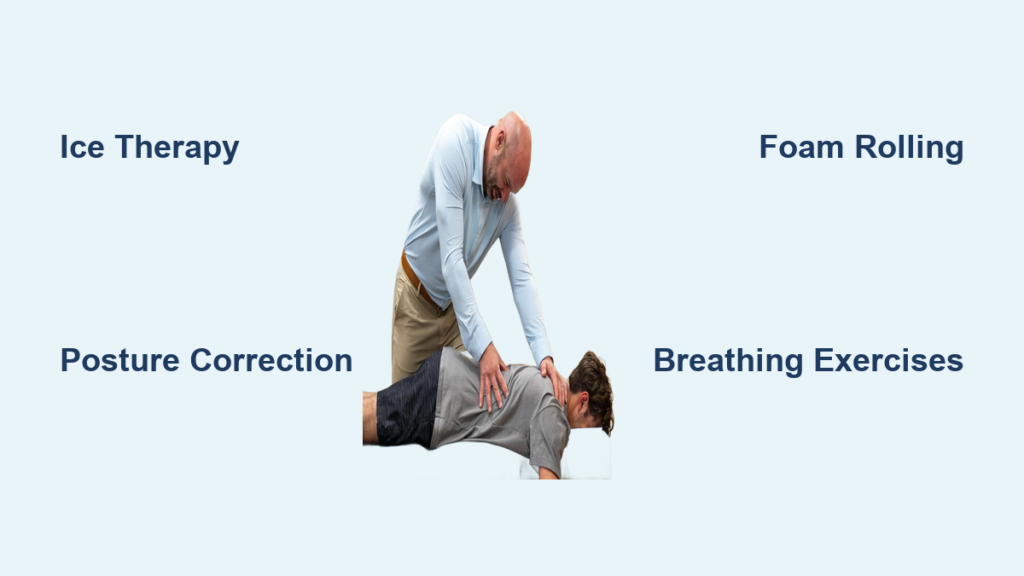
When mid back pain strikes suddenly, ice therapy becomes your first line of defense. Apply cold packs for 15-20 minutes every 2-3 hours during the initial 48-72 hours to reduce inflammation and numb pain receptors. Skip heat initially—it increases inflammation in acute phases.
Gentle breathing exercises maintain costovertebral joint mobility without aggravation. Lie supine with knees bent, place one hand on your chest and one on your belly. Inhale deeply through your nose, ensuring your belly hand rises more than your chest hand. Complete 3 sets of 10 breaths twice daily.
Postural modification prevents worsening mechanical stress. Place a small rolled towel behind your mid back when sitting to encourage gentle extension. Set phone reminders for hourly micro-breaks—stand up, perform shoulder blade squeezes, or walk to reset your posture.
Quick Desk Relief That Works in 60 Seconds
Transform your workspace immediately with wall angels: Stand with your back against a wall, arms bent at 90 degrees. Slowly raise and lower your arms like making snow angels while maintaining contact with the wall. Perform 2 sets of 10-15 repetitions to activate postural muscles without strain.
Thread-the-needle stretch provides instant relief: On hands and knees, slide one arm under your body with palm up, turning your chest toward the ceiling. Hold 30 seconds each side to release tight rhomboids causing that “knot” between your shoulder blades.
Follow This Progressive Mid Back Pain Therapy Protocol
Weeks 1-2: Foundation Building for Pain Reduction
Start with supine diaphragmatic breathing: 3 sets of 10 breaths twice daily. This simple exercise restores proper breathing mechanics often compromised by mid back pain.
Gentle thoracic rotation in hook-lying position follows: While lying on your back with knees bent, gently rotate your knees side to side while keeping shoulders grounded. Perform 2 sets of 10 repetitions each direction, staying within pain-free ranges.
Scapular setting exercises build endurance: Lie face-down, gently squeeze shoulder blades together and down, hold 5 seconds, release. Complete 3 sets of 15 repetitions to activate mid-back stabilizers without strain.
Weeks 3-4: Restore Critical Thoracic Mobility
Foam roller thoracic extensions become essential: Position a foam roller horizontally across your mid back while lying supine. Support your head with hands, gently arch backward over the roller, hold 2-3 seconds, return to neutral. Perform 3 sets of 15 repetitions, moving the roller up and down your thoracic spine.
Quadruped thoracic rotation improves segmental mobility: Start on hands and knees, place one hand behind your head, rotate your elbow toward the ceiling while keeping hips stable. Complete 3 sets of 10 repetitions each side with smooth, controlled movements.
Prone Y-T-W raises strengthen postural muscles: Lie face-down, lift arms into Y position (overhead), then T (out to sides), then W (bent elbows). Perform 2 sets of 10 in each position, emphasizing quality over quantity.
Weeks 5-8: Build Functional Strength to Prevent Recurrence
Resistance band rows develop critical pulling strength: Anchor a resistance band at chest level, pull toward your sternum while squeezing shoulder blades together. Complete 3 sets of 12-15 repetitions, maintaining neutral spine throughout.
Dead bugs with breathing focus integrate core stability: Lie on your back, arms reaching up, knees bent at 90 degrees. Slowly extend opposite arm and leg while maintaining diaphragmatic breathing. Perform 3 sets of 10 each side, ensuring your low back stays pressed to the floor.
Bird-dog variations challenge full-body stability: Start on hands and knees, extend opposite arm and leg while maintaining neutral spine. Progress by drawing elbow to knee under your body, then extending back out. Perform 3 sets of 10 each side for maximum carryover to daily activities.
Transform Your Workspace to Eliminate Mid Back Pain Triggers
Immediate Desk Modifications That Deliver Results
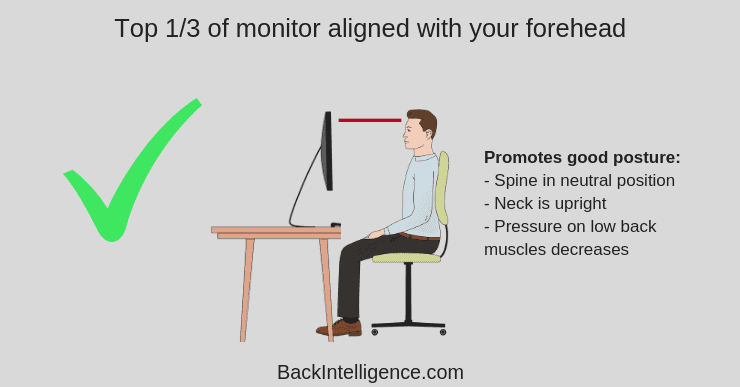
Monitor positioning makes or breaks your mid back health. Position your screen at eye level, approximately arm’s length away. If using a laptop, invest in a separate keyboard and mouse so you can elevate the screen without compromising wrist position.
Chair selection requires attention to thoracic support. Choose chairs with adjustable lumbar support positioned to support your mid back’s natural curve. Add a small cushion at mid back level if your current chair lacks support.
Standing desk transitions every 30-45 minutes interrupt static postures. Start with 15-minute standing sessions, gradually increasing duration as your endurance improves—this simple change reduces mechanical stress by 40%.
Sleep Position Adjustments for Nighttime Pain Relief
Mattress firmness significantly impacts your thoracic spine. Medium-firm mattresses provide optimal support—replace mattresses older than 8-10 years as they lose supportive properties.
Pillow strategy maintains neutral spine alignment: Side sleepers need a pillow filling the space between ear and shoulder; back sleepers require thinner pillows supporting natural neck curve. Avoid multiple pillows that push your head forward.
Position modifications reduce nighttime stress: Side-sleepers should place a pillow between knees; back-sleepers benefit from a small pillow under knees to reduce thoracic extension demands.
Track Progress and Prevent Mid Back Pain Recurrence
Monthly Maintenance Protocol for Long-Term Success
Week 1: Focus on mobility—foam roller thoracic extensions, thread-the-needle stretches, and breathing exercises. Dedicate 15-20 minutes daily to maintaining range of motion.
Week 2: Emphasize strength—resistance band rows, bird-dog variations, and prone Y-T-W raises. Maintain 2-3 strength sessions weekly to preserve muscle balance.
Week 3: Integrate function—incorporate movements from your sport or daily activities with focus on thoracic mechanics.
Week 4: Assess and adjust—evaluate pain levels, range of motion, and functional capacity to modify your program.
Critical Warning Signs Needing Professional Evaluation
Persistent neurological symptoms require imaging: Numbness, tingling, or weakness lasting more than 2 weeks despite conservative care may indicate disc herniation.
Failed conservative trial triggers advanced interventions: If you’ve completed 6-8 weeks of appropriate therapy without significant improvement, consider MRI evaluation.
Most individuals experience significant improvement within 4-6 weeks of consistent mid back pain therapy. Start with acute phase strategies, progress systematically through the exercise protocol, and integrate ergonomic changes into your daily life. Remember, consistency trumps intensity—dedicate 10-15 minutes daily to your prescribed exercises rather than hour-long weekly sessions.
Your thoracic spine supports you through every breath, reach, and rotation—invest in its health through targeted mid back pain therapy, and it will support you through decades of active living.