
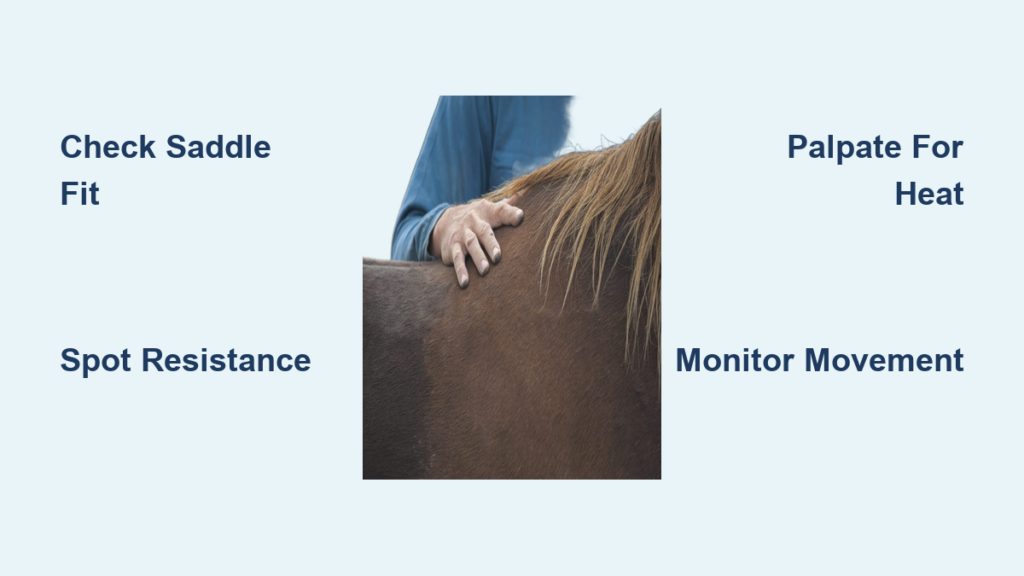
Your normally willing jumper suddenly refuses fences it cleared last week, or your dressage partner resists bending through their body—these aren’t just “training issues.” When your horse develops unexplained performance problems, horse back pain is likely the hidden culprit. Unlike obvious lameness, back discomfort often masquerades as behavioral problems, causing riders to push through discomfort until permanent damage occurs. Recognizing these subtle warning signs early separates horses that enjoy long athletic careers from those prematurely sidelined.
Recent veterinary research reveals that 85.7% of horses with back pain show reduced hindlimb impulsion, yet most owners mistake this for laziness or poor training. This guide transforms you into your horse’s first line of defense by teaching evidence-based assessment techniques used by equine specialists. You’ll learn to spot early indicators, accurately grade severity, and implement targeted interventions before minor discomfort becomes career-ending damage.
Identify Hidden Performance Warning Signs
Pinpoint Specific Movement Changes That Signal Discomfort
Horses with horse back pain develop distinct movement patterns that riders frequently misinterpret as disobedience. Instead of labeling your horse “stubborn,” look for these clinically validated indicators:
- Resistance during lateral work: 64.3% of affected horses refuse or struggle with movements requiring spinal flexibility
- Inconsistent hindlimb engagement: Watch for sudden loss of power during transitions or uphill work
- Abnormal head carriage: Elevated head position or excessive neck tension often accompanies back pain
- Difficulty maintaining collection: Horses drop out of frame or rush to avoid using their back correctly
These changes represent pain responses—not attitude problems. When your horse avoids movements that stress their back, they’re communicating discomfort you must address before compensation patterns cause permanent musculoskeletal changes.
Detect Physical Clues During Daily Grooming
Your pre-ride grooming session holds critical diagnostic information most riders miss. While brushing, watch for these physical markers:
- Muscle spasms: 78.6% of horses with back pain show visible twitching when pressure is applied along the longissimus dorsi
- Asymmetrical muscle development: Compare both sides of the spine—42.9% exhibit noticeable epaxial muscle atrophy
- Localized heat: Run your hand down the back to detect warm patches indicating inflammation
- Focal swelling: 21.4% develop discrete bumps along the thoracolumbar region signaling injury
Don’t dismiss saddle marks as “normal rubbing.” Pressure points from ill-fitting tack contribute to 21.4% of back pain cases and require immediate saddle evaluation.
Master the Five-Point Pain Assessment System

Score Pain Response Using Clinical Grading Criteria
Forget guessing—use this veterinarian-validated system to objectively measure your horse’s discomfort. Apply firm but gentle digital pressure along the dorsal midline while observing reactions:
| Severity Level | Pain Response Characteristics | Action Required |
|---|---|---|
| Mild (1-2) | Occasional reaction only to firm pressure | Saddle check, modify exercise |
| Moderate (3-4) | Consistent avoidance during palpation | Veterinary evaluation within 48 hours |
| Severe (5) | Violent reaction to light touch | Immediate veterinary attention |
Critical mistake to avoid: Don’t test only one spot. Horses with back pain typically show focal sensitivity in specific vertebrae regions. Work systematically from withers to croup, comparing left and right sides.
Measure Muscle Hypertonicity Correctly
Muscle tightness provides crucial diagnostic information beyond simple pain response. While applying steady pressure:
- Grade mild tightness as “1” if muscles feel ropey but show no visible spasms
- Score moderate spasms as “3” when fasciculations (muscle twitching) occur spontaneously
- Mark severe cases as “5” when persistent cramping prevents normal movement
Remember that horses naturally reduce visible pain responses by 75% when handlers are present. For accurate assessment, have someone else hold your horse while you palpate—this reveals true discomfort levels masked during routine handling.
Eliminate Common Back Pain Causes Immediately
Rule Out Saddle Fit Issues in 5 Minutes
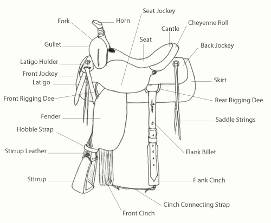
An ill-fitting saddle causes or exacerbates back pain in over 20% of cases. Perform this quick check before mounting:
- Place saddle on bare back without pad
- Check for even contact along both panels
- Verify clearance over the withers (two fingers minimum)
- Ensure no pressure points exist behind the shoulder
- Watch for saddle shifting during mounting
Red flag: If you see white hair or pressure sores after riding, stop using that saddle immediately. Continued use risks permanent tissue damage even after the saddle is corrected.
Identify Secondary Lameness Compensations
Back pain frequently stems from horses compensating for limb discomfort. Watch for these telltale signs:
- Head bobbing that worsens when bending in one direction
- Uneven weight distribution when standing at rest
- Reluctance to step under with a particular hind leg
- Circles that are significantly easier in one direction
If you suspect secondary lameness, consult your veterinarian before addressing back issues—the underlying limb problem must be resolved first to prevent recurring back pain.
Implement a Targeted Recovery Plan
Follow This 4-Week Rehabilitation Timeline
Treatment effectiveness depends on accurate severity grading. For mild cases (scores 1-4):
- Days 1-3: Complete rest with hand-walking only
- Week 1: 10 minutes daily of walking under saddle
- Week 2: Add 5-minute trot intervals on straight lines
- Week 3: Introduce gentle lateral work at walk
- Week 4: Gradually resume normal training intensity
Pro tip: Document daily progress using the pain grading system. If scores don’t decrease by at least 1 point every 7 days, consult your veterinarian about alternative treatments.
Prevent Recurrence With Daily Maintenance
Successful long-term management requires consistent monitoring. Build these habits into your routine:
- Morning check: Lightly palpate key points before riding
- Post-ride assessment: Note any new sensitivity or resistance
- Weekly saddle check: Verify fit as horse’s musculature changes
- Monthly flexibility tests: Monitor bending willingness through range of motion
Horses with previous back issues need professional bodywork every 4-6 weeks to maintain suppleness. Combine this with targeted core strengthening exercises to build protective musculature along the spine.
Know When to Call the Veterinarian Immediately
Recognize Emergency Warning Signs
While mild cases often resolve with rest and management changes, these symptoms demand urgent veterinary attention:
- Violent reaction to light touch anywhere on the back
- Inability to stand comfortably or assume normal posture
- Complete refusal to move forward under saddle
- Visible swelling or heat covering multiple vertebrae
Critical insight: Moderate to severe cases (scores 9-20) typically require diagnostic imaging to identify specific lesions. Don’t waste valuable recovery time with guesswork—early intervention prevents chronic conditions.
Understand Diagnostic Limitations
Even with veterinary help, diagnosing equine back pain remains challenging. Your veterinarian will likely:
- Rule out primary lameness through flexion tests
- Perform detailed palpation under controlled conditions
- Assess response to diagnostic nerve blocks
- Recommend imaging (x-rays, ultrasound) if indicated
Remember that individual pain perception varies significantly between horses. Some “cold-backed” individuals show exaggerated reactions without underlying pathology, while stoic horses may hide severe discomfort.
Final Takeaway: Horse back pain rarely announces itself with obvious symptoms—instead, it whispers through subtle performance changes and physical clues most riders overlook. By implementing this systematic assessment approach, you transform from frustrated rider to proactive pain detective. The five-parameter grading system gives you objective tools to track problems and recovery, while targeted interventions prevent minor discomfort from becoming career-ending damage. Remember that 42.86% of affected horses present with mild-moderate symptoms treatable with early intervention—don’t wait for severe signs before acting. Your horse’s competitive longevity depends on recognizing these hidden signals and responding with precision before permanent damage occurs. Start your daily monitoring routine today, and become the advocate your horse needs for a pain-free athletic career.