
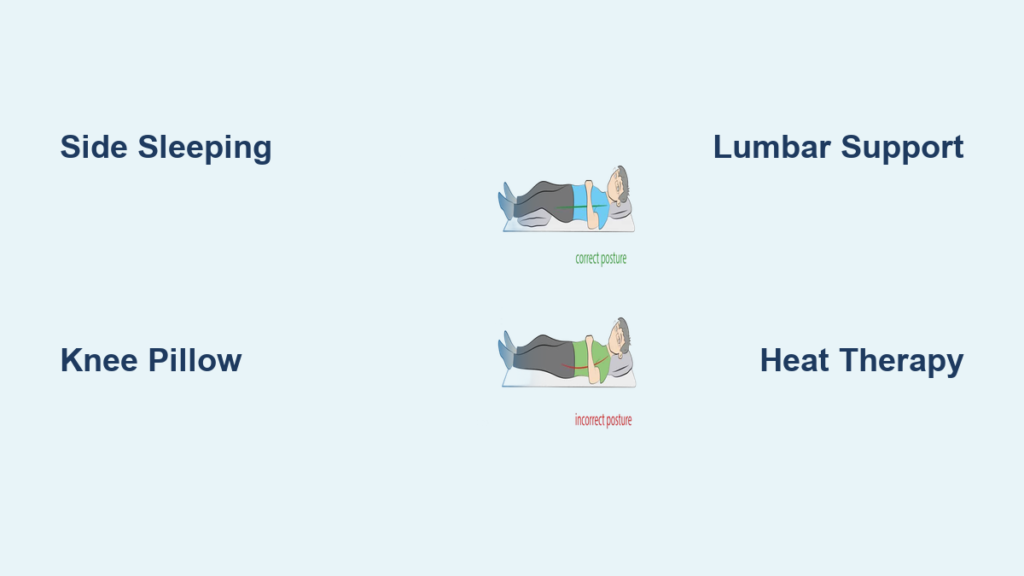
Waking up with shooting leg pain or a stiff lower back after a night of poor sleep is a frustrating reality for millions battling sciatica and back pain. While you’re trying to rest, your sleeping position might be silently worsening the nerve compression that causes that burning sensation down your leg. The wrong position can keep your sciatic nerve pinched for hours, turning what should be restorative sleep into a pain amplifier that leaves you worse off in the morning.
You don’t have to accept sleepless nights as inevitable with lower back pain and sciatica. Strategic positioning and simple bedroom adjustments can transform your bed from a pain trigger to a healing environment. This guide delivers specific, actionable solutions to help you finally get the deep, restorative sleep your body needs to recover—without expensive equipment or complicated routines.
Side Sleeping with Proper Alignment for Sciatica Relief
Side sleeping emerges as your most effective position against nighttime sciatica pain because it naturally decompresses the lumbar spine while preventing the sciatic nerve from getting pinched between vertebrae. The key is maintaining proper hip alignment throughout the night.
Perfect your side-sleeping setup with these critical adjustments:
– Slide a firm pillow between your knees—this single change prevents your upper leg from twisting your spine out of alignment
– Position the pillow so your hips stay perfectly parallel all night (look for hourglass-shaped knee pillows that stay in place)
– Curl into a gentle fetal position, bringing knees toward chest to create space between vertebrae
– Place a thin pillow or rolled towel under your waist to support your spine’s natural S-curve
– Choose a neck pillow that keeps your head neutral—not elevated or dropped
Pro tip: If you wake with sciatica pain despite knee pillows, try placing a second pillow behind your back to prevent rolling onto your stomach during sleep. This small addition creates a barrier that maintains proper positioning.
Back Sleeping with Knee Support for Lower Back Pain
Back sleeping distributes your body weight evenly while keeping your spine in neutral alignment—when properly supported. The critical mistake most people make is sleeping flat on their back without elevation.
Create optimal back-sleeping support with these precise steps:
– Slide a pillow under your knees to reduce lower back pressure by 25-30% (use a pillow that elevates knees 4-6 inches)
– Add a small lumbar roll under your lower back’s natural curve—this should fill the gap without over-arching
– Keep your head pillow thin—thicker than 3 inches often pushes your head forward, straining neck muscles
– Elevate your legs 30-45 degrees using a wedge pillow for severe sciatica flare-ups
Warning: Skip back sleeping if you experience sleep apnea, as this position can worsen breathing issues and disrupt sleep quality. Test this position for just one night to assess its impact on your specific pain pattern.
Mattress Firmness That Reduces Morning Back Pain

Your mattress firmness directly impacts morning pain levels more than you might realize. Medium-firm surfaces typically provide the best balance, but your body weight determines the ideal firmness level.
Firmness guidelines by body weight:
– Under 130 lbs: Medium-soft (4-5/10 firmness) prevents excessive sinking
– 130-230 lbs: Medium-firm (6-7/10 firmness) offers optimal support
– Over 230 lbs: Firm (7-8/10 firmness) prevents spinal misalignment
Test before buying: Most quality mattress companies offer 100-night trials—use them to find your optimal firmness. When testing, pay attention to how your lower back feels after 3-4 hours of sleep, not just the initial comfort.
Pre-Bed Stretching Routine for Sciatica Sufferers
Five minutes of targeted stretching can reduce nighttime pain by releasing tension in the muscles compressing your sciatic nerve. Timing matters—complete these stretches 30-60 minutes before bed, not immediately before sleep.
Evening stretch routine (hold each 30-60 seconds):
1. Knee-to-chest stretch: Lie on back, pull one knee toward chest while keeping other leg straight
2. Figure-4 piriformis stretch: Cross ankle over opposite knee, gently pull toward chest
3. Supine hamstring stretch: Lie on back, use towel to pull straight leg toward ceiling
4. Child’s pose: Kneel and fold forward, arms extended, to gently stretch lower back
Expert note: Focus on gentle, sustained stretches rather than bouncing movements. You should feel mild tension, not pain. If stretching increases your sciatica symptoms, stop immediately and consult a physical therapist.
Strategic Pillow Placement for Lower Back Support
Not all pillows provide equal relief for sciatica sufferers. The right pillow placement creates targeted support where your spine needs it most.
Lumbar support pillow positioning:
– Side sleeping: Place between waist and mattress to prevent sagging (use 1-2 inch thickness)
– Back sleeping: Position in the small of your back to maintain natural curve
– Stomach sleeping: Place under pelvis to reduce lumbar hyperextension (thinnest option)
Pro tip: When traveling, roll up a bath towel for lumbar support—this improvised pillow maintains proper spinal alignment in unfamiliar beds.
Heat Therapy Protocol for Nighttime Pain Relief

Applying heat therapy 20-30 minutes before bed relaxes muscles and increases blood flow to affected areas, reducing pain perception during sleep.
Effective heat therapy methods:
– Use heating pad on low-medium setting for 20 minutes before bed
– Take warm baths with Epsom salts 1 hour before sleep (magnesium reduces muscle tension)
– Apply microwavable heat packs to specific trigger points for 15 minutes
Critical timing: Never apply heat immediately before lying down—give your body time to cool slightly to prevent overheating during sleep. Heat therapy works best when followed by gentle stretching.
Safe Morning Transition Sequence for Less Pain
How you exit bed determines your morning pain level more than you might realize. Poor morning movement patterns can undo any nighttime relief you achieved.
Step-by-step morning transition:
1. Roll to side: Use arm support to roll onto your side, avoiding twisting at the waist
2. Slide legs: Move both legs together over bed edge while supporting upper body
3. Push up: Use arms to push to sitting position without bending forward
4. Pause: Sit for 30-60 seconds before standing to allow circulation to normalize
5. Stand tall: Engage core muscles while rising to avoid forward bending
Warning: Never swing your legs off the bed while simultaneously pushing up with your hands—that motion compresses discs in your lower back. Take it slow and use proper mechanics.
When to Consult a Physical Therapist for Sleep Positioning
While home adjustments help many people, professional guidance becomes essential when pain persists despite position changes. A physical therapist can customize positioning strategies based on your specific pain patterns.
Physical therapy provides:
– Personalized pillow recommendations based on spinal measurements
– Manual therapy for muscular imbalances contributing to poor sleep positioning
– Specific exercises targeting your unique pain pattern
– Professional fitting for positioning devices
Red flags requiring immediate care: Seek emergency attention for sudden loss of bladder or bowel control, progressive leg weakness, or numbness in the “saddle” area (inner thighs/groin). These symptoms indicate serious nerve compression requiring urgent intervention.
Long-Term Sleep Success Strategies for Chronic Back Pain
Transforming your sleep with chronic back pain requires consistency across multiple factors. Your circadian rhythm affects pain perception hormones, making regular sleep patterns crucial for long-term relief.
Sleep schedule optimization:
– Keep the same bedtime/wake time within 30 minutes, even on weekends
– Limit naps to 20 minutes maximum and avoid napping after 3 PM
– Use bright light exposure within 30 minutes of waking to regulate circadian rhythm
Dietary impact on sleep quality:
– Avoid caffeine after 2 PM to prevent increased muscle tension
– Skip alcohol within 4 hours of bedtime—it disrupts restorative sleep stages
– Try tart cherry juice 2 hours before bed for natural anti-inflammatory benefits
– Sip chamomile tea 30 minutes before sleep for gentle relaxation
Pro tip: Keep a sleep and pain diary for 2 weeks to identify patterns between positioning, foods, and pain levels. Note which positions provide the most relief and any factors that worsen symptoms—this information is invaluable for healthcare providers.
Transforming your sleep with lower back pain and sciatica isn’t about finding one perfect position—it’s about creating a comprehensive system that addresses positioning, environment, and pain management. Start tonight with one simple change: adjust your pillow placement between your knees when side sleeping. Notice how your morning feels different. Build from there, adding layers of support until you wake up refreshed instead of regretful. Your spine—and your sleep quality—will thank you with better days ahead.