
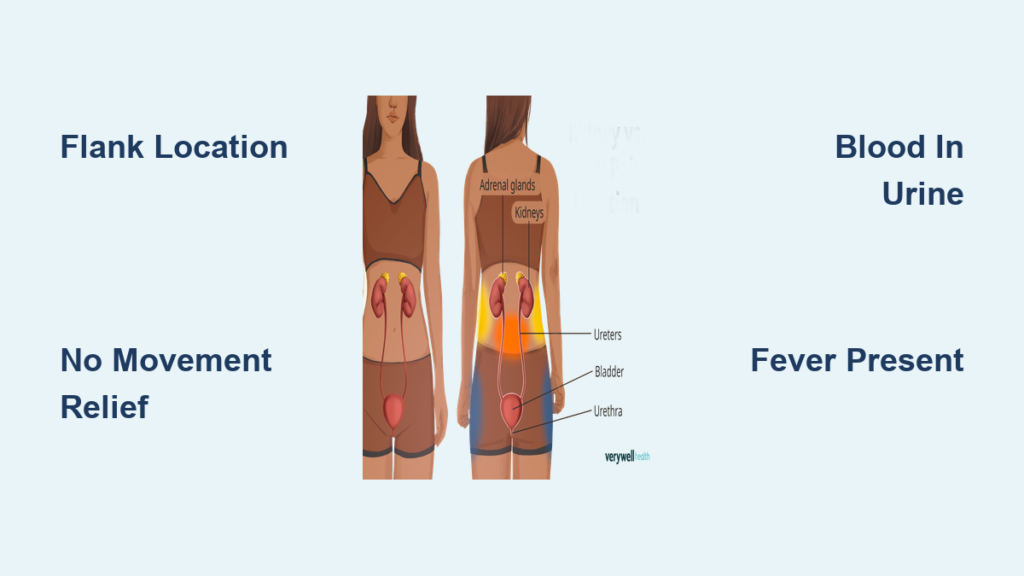
You wake up with a deep ache in your side, unsure if it’s just yesterday’s intense workout or something far more serious. That persistent discomfort could signal anything from a simple muscle strain to a kidney stone requiring emergency care. Distinguishing kidney pain from back pain isn’t just medical trivia—it’s practical knowledge that prevents dangerous delays in treatment. When kidney pain masquerades as ordinary backache, misidentification can lead to complications like permanent kidney damage or sepsis from untreated infection.
The confusion happens because both pain types occupy overlapping territory in your torso. But your body broadcasts distinct signals if you know what to listen for. This guide cuts through the uncertainty using clinically proven differentiation techniques you can apply at home. By the end, you’ll confidently recognize whether that ache demands a stretching routine or an immediate trip to the ER.
Pinpoint Your Exact Pain Location
Kidney pain anchors itself in your flank—the area just below your rib cage on either side of your spine. Imagine placing your hands on your hips with thumbs pointing backward; your kidneys sit precisely where your thumbs rest against your back. This pain often shoots toward your groin or inner thigh as kidney stones travel down the ureter. Crucially, it typically affects one side but can occur on both simultaneously during severe infections.
Back pain, however, dominates your lower back or buttocks and rarely stays confined to the flank zone. Muscle strains cause discomfort centered along your spine or across your lower back width, while sciatica radiates down your legs in sharp, electric paths. If pressing your palm directly over your spine reproduces the pain, it’s almost certainly musculoskeletal—not kidney-related.
Location Red Flags
- Kidney pain: Deep ache under lowest ribs, radiating to groin
- Back pain: Surface-level soreness along spine or across lower back
- Critical distinction: Flank pain without leg radiation suggests kidney involvement
Test Pain Response to Movement

Here’s the game-changer: kidney pain ignores your body position. Whether you’re curled in bed or attempting a yoga pose, the intensity stays stubbornly constant. This happens because kidney pain stems from internal processes like stone movement or infection swelling—not muscle activity. You won’t find relief by changing positions or resting.
Back pain, conversely, reacts dramatically to movement. Bending to tie shoes might trigger stabbing spasms. Twisting to grab something from your car could send shooting pain down your leg. The pain improves with rest and worsens with specific motions like lifting or prolonged sitting. This movement-dependency is your body’s built-in diagnostic tool for musculoskeletal issues.
Quick Home Movement Test
- Kidney pain: No change when arching backward or lying still
- Back pain: Intensifies with bending, twisting, or coughing
- Try this: Gently rotate your torso—if pain spikes during motion, suspect back strain
Decode Urinary Symptoms
:max_bytes(150000):strip_icc()/vwh_rush_evergreen_illo_pee_color_chart1-0740848f16e948bbb883c7f1176cb37d.jpg)
Kidney problems announce themselves through distinct urinary changes that back pain never causes. If you notice burning during urination, an urgent need to go despite an empty bladder, or—most tellingly—pink, red, or cola-colored urine, your kidneys are signaling distress. Cloudy or foul-smelling urine often accompanies infections like pyelonephritis.
Back pain, no matter how severe, won’t alter your urine. The absence of urinary symptoms during lower back discomfort strongly points to musculoskeletal causes. Never dismiss visible blood in urine as “just a strain”—this requires immediate medical evaluation.
Must-Check Urine Clues
- Kidney warning: Blood (any color change), burning sensation, frequent small voids
- Back pain indicator: Normal urine color and flow
- Emergency sign: Visible blood + flank pain = call your doctor now
Perform the Costovertebral Angle Tap Test
This simple self-exam delivers critical diagnostic insight. Lightly tap your flank area with a closed fist—about midway between your spine and side, just below the rib cage. If this gentle percussion causes sharp tenderness, your kidneys are likely inflamed or infected. This test specifically targets the costovertebral angle where kidney issues manifest.
Back pain won’t respond to this flank percussion. Instead, pressing directly on your lower back muscles or spine reproduces the discomfort. The key difference? Kidneys hurt when tapped from behind, while strained muscles hurt when pressed directly on the sore spot.
Self-Test Protocol
- Locate your flank (below rib cage, outer spine)
- Gently tap with fist 3-4 times
- Positive sign: Sharp pain from light tapping
- Negative sign: No pain when tapping flank
Identify Fever and Systemic Symptoms

Your body’s whole-system response provides undeniable clues. Kidney infections trigger fever above 101°F (38.3°C), chills, and nausea—your immune system fighting a serious internal threat. You might feel profoundly exhausted with no apparent cause beyond the flank pain. These systemic symptoms never accompany simple back strain.
Back pain might make you miserable, but it won’t spike your temperature or cause vomiting. If you have lower back discomfort with fever, suspect either kidney infection or a rare spinal infection—but never ignore this combination.
Symptom Comparison Chart
| Kidney Infection | Back Strain |
|---|---|
| Fever >101°F | Normal temperature |
| Nausea/vomiting | No digestive issues |
| Whole-body chills | Localized discomfort only |
| Fatigue/malaise | Pain improves with rest |
Analyze Pain Quality and Patterns
:max_bytes(150000):strip_icc()/kidney-pain-vs-back-pain-7093864-edit-6e93be22380e44cc9811ca9b12ba9312.jpg)
The texture of your pain tells a vital story. Kidney stone pain arrives in intense, wave-like surges—peaks of excruciating pain followed by brief lulls as the stone shifts. Infection-related kidney pain feels like a deep, unrelenting ache that ignores position changes. Both types feel visceral and internal, like something’s wrong inside your body.
Back pain follows predictable patterns: muscle strain produces throbbing stiffness that eases with heat and gentle movement, while nerve compression causes shooting, electric sensations down your legs. Back pain rarely comes in waves—it either steadily worsens with activity or gradually improves with rest.
Pain Pattern Checklist
- Kidney stones: Sudden, colicky waves of severe pain
- Kidney infection: Constant deep ache without relief
- Muscle strain: Dull throb worsening with movement
- Sciatica: Burning leg pain triggered by sitting
Conduct Visual Inspection for Clues
Your eyes can confirm what your body feels. Check for visible muscle spasms along your lower back—tight, rope-like bands indicate musculoskeletal strain. Look for bruising, swelling, or asymmetry in the painful area, which suggests recent injury rather than internal organ issues.
Kidney pain rarely shows external signs. The inflammation stays deep beneath muscle layers. However, noticeable posture changes like leaning to one side (antalgic gait) point strongly to back problems. If you see nothing unusual but feel deep flank pain, prioritize kidney evaluation.
Visual Red Flags
- Back pain signs: Muscle knots, bruising, postural shifts
- Kidney indicators: No visible changes despite severe pain
- Urgent need: Flank pain + fever with no external cause
Recognize When Home Tests Fail
While these techniques help distinguish common cases, certain symptoms require immediate ER visits regardless of your assessment. Severe flank pain with vomiting could mean a kidney stone too large to pass. Fever with flank tenderness signals possible pyelonephritis needing IV antibiotics. Never wait 24 hours with these warning signs.
Cauda equina syndrome—a rare spinal emergency—causes back pain with new incontinence or saddle numbness. This requires surgery within 48 hours to prevent permanent paralysis. When pain prevents finding any comfortable position, seek help immediately—your body is screaming for intervention.
Emergency Warning Signs
- Fever over 101°F with flank pain
- Visible blood in urine
- Inability to urinate or loss of bowel control
- Pain so severe you can’t sit still
Implement Prevention Strategies That Work
Hydrate aggressively—2.5-3 liters daily—to flush kidney-stone-forming minerals and cut stone risk by 40%. Strengthen your core with planks and bridges to support your spine and prevent back strain. Limit sodium to 2,300mg daily (about 1 teaspoon) to reduce calcium excretion that forms stones.
For back health, adjust your workstation so computer screens sit at eye level and chair supports your lumbar curve. Take micro-breaks every 30 minutes to stretch—sitting longer than an hour increases disc pressure by 40%. These small habits prevent 70% of recurrent back pain episodes.
Daily Prevention Habits
- Hydration: Sip water constantly (urine should be pale yellow)
- Posture: Reset spine alignment hourly when sitting
- Lifting: Bend knees, keep objects close to body
- Diet: Add citrus (lemon water) for stone prevention
Key Takeaways for Immediate Action
Remember these three diagnostic pillars when pain strikes: Location (flank vs lower back), Movement Response (unchanged vs activity-dependent), and Urinary Symptoms (present vs absent). If two point to kidney issues—like flank pain with blood in urine—seek care within hours, not days.
Your body provides sophisticated diagnostic data—you just need this decoding toolkit. Trust symptom combinations over single indicators. Flank pain with fever demands different action than lower back stiffness that eases with stretching. With this knowledge, you transform uncertainty into informed decisions that protect your health. When in doubt, especially with fever or bloody urine, get checked—your kidneys can’t wait.