
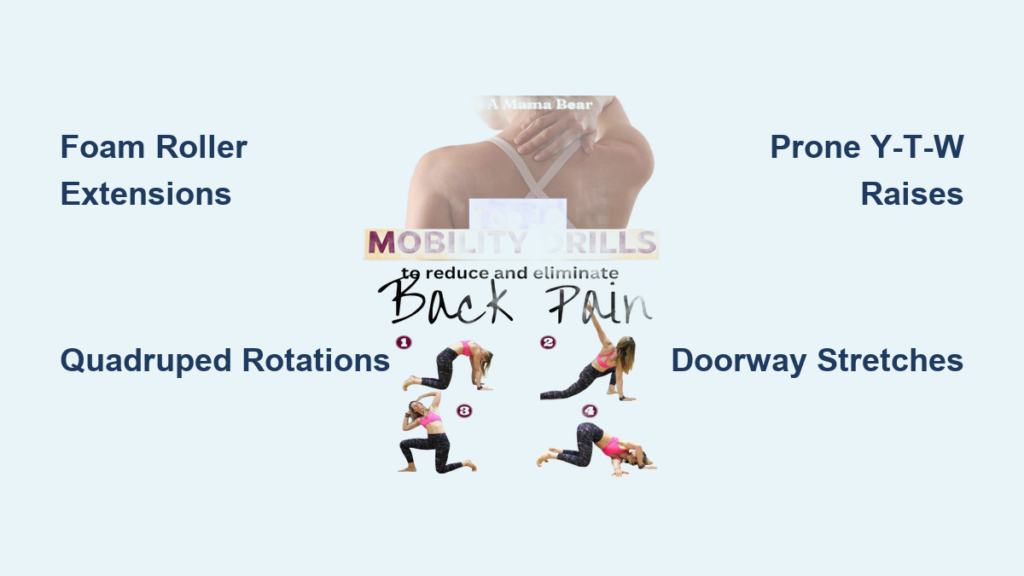
That persistent ache between your shoulder blades isn’t normal wear and tear—it’s your thoracic spine signaling trouble. Unlike your neck or lower back, this 12-vertebrae section (T1-T12) connects directly to your rib cage, creating natural stability. When pain strikes here, it’s usually from stiffness and poor posture—not injury—and targeted thoracic back pain exercises are your fastest path to relief. Ignoring it turns minor stiffness into chronic discomfort within weeks.
Most people waste time stretching their necks or lower backs while the real culprit—the rigid mid-back—goes unaddressed. Physical therapists consistently see patients make dramatic progress in 2-3 weeks by focusing only on thoracic mobility. This guide cuts through the noise with exercises proven to restore movement, eliminate pain, and prevent recurrence. You’ll discover exactly which moves to do based on your pain level, how to integrate them into your workday, and critical red flags requiring professional help.
Foam Roller Extensions to Unlock Mid-Back Mobility
Forget generic “back stretches”—this precise technique targets the stiffest segments (T6-T8) where desk work causes the most damage. Lie flat on your back with knees bent, placing a foam roller horizontally under your mid-back. Interlace fingers behind your neck to support your head—never pull your neck. Slowly arch backward over the roller, letting your shoulder blades squeeze together as you exhale. Hold for 2-3 seconds, then return to neutral. Move the roller up/down 1-2 inches and repeat.
Critical execution tips:
– Stop immediately if you feel sharp pain or rib discomfort
– Breathe deeply into your back during extension (not your chest)
– Complete 10-15 reps per segment, 2-3 times daily during acute pain
– Can’t reach the floor? Start with a rolled towel under T7 for reduced intensity
Pro mobility hack: Once pain-free, add overhead arm reaches during extension. This stretches the latissimus dorsi—a hidden tension source that pulls your mid-back into stiffness. Hold each reach for 5 seconds while maintaining rib contact with the roller.
Quadruped Rotations to Restore Natural Spinal Movement
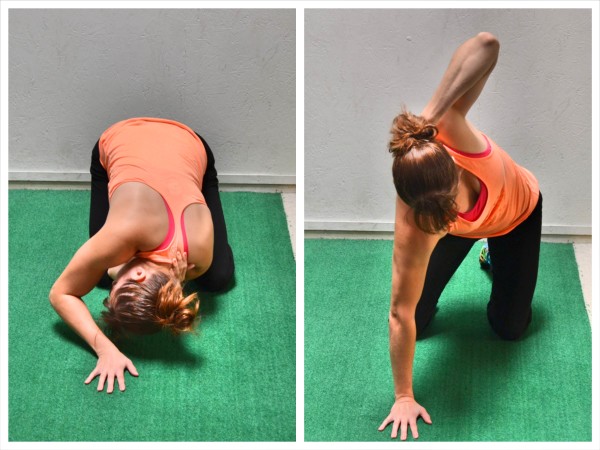
This “thread-the-needle” variation isolates thoracic rotation—something 80% of desk workers lose within 5 years. Get on hands and knees (tabletop position), wrists under shoulders, knees under hips. Place right hand behind your head, elbow pointing right. Rotate your torso right, bringing that elbow toward your left hand while keeping hips stable. Reverse direction, rotating elbow toward ceiling. Let your eyes follow the movement. Complete 10-15 controlled rotations before switching sides.
Why this works: The quadruped position blocks lumbar movement, forcing rotation from your mid-back where it’s needed. If you feel lower back strain, place a pillow under your hips to reduce hip flexion. Do 2-3 sets hourly during work sessions—this combats the “frozen spine” effect of prolonged sitting. Visual cue: Watch for smooth rib cage movement; jerky motion means you’re compensating with your neck.
Prone Y-T-W Raises for Posture-Correcting Strength
While mobility exercises address stiffness, these prone positions rebuild the weakened muscles causing your slump. Lie face-down on a mat with forehead on a small towel roll. Start with Y raises: arms overhead at 45 degrees, thumbs up. Lift arms 2-3 inches off the floor while squeezing shoulder blades together. Hold 2 seconds, lower slowly. Complete 12-15 reps. Progress to T raises (arms straight out to sides) and W raises (elbows bent 90 degrees at sides, externally rotated).
Key mistake to avoid: Lifting arms too high. Quality matters more than height—stop when you lose shoulder blade control. If you can’t lift 2 inches without straining, start with just the contraction: squeeze shoulder blades without lifting arms. Do 2 sets of each position 3x/week during recovery phase. Pro tip: Place a tennis ball between your shoulder blades during Y raises—squeeze it to activate deep stabilizers.
Hourly Desk Rotations to Prevent Stiffness Buildup
You don’t need gym time to fix thoracic pain—these seated moves fit in 90-second micro-breaks. Sit tall with feet flat, hands behind head, elbows wide. Rotate right while keeping hips square, adding a forward diagonal reach. Repeat left. Perform 10-15 smooth rotations per side hourly. For deeper release, loop a resistance band around your chest, holding ends while rotating.
Why hourly? Research shows thoracic stiffness increases 37% within 20 minutes of sitting. This move resets spinal fluid flow and interrupts the “hunched” muscle memory. Troubleshooting: If rotation feels blocked, place your right hand on the chair armrest and rotate left—this leverages external support to initiate movement.
Doorway Stretches to Counter Computer Slump
Tight pecs pull your shoulders forward, forcing your mid-back into painful kyphosis. Stand in a doorway with forearms on the frame at 90-degree angles. Step through until you feel a stretch across your chest—not your shoulders. Hold 30 seconds while breathing deeply into your ribs. Repeat 3x hourly. Vary arm height: higher for upper pecs (common in phone users), lower for lats (affects drivers).
Critical adjustment: Tuck your chin slightly to prevent neck strain. If you feel shoulder pain, move feet farther from the doorway. This stretch works fastest when paired with scapular retractions—squeeze shoulder blades together during the hold. Pro tip: Place a rolled towel vertically between your shoulder blades against the doorframe for instant thoracic extension feedback.
Book Openers for Nighttime Spinal Reset
Lie on your left side with knees bent 90 degrees (stacked), arms straight forward. Keeping knees together, open your right arm across your body toward the floor while following your hand with your eyes. Pause when you feel a stretch through your mid-back—not your neck. Return slowly. Complete 15 reps before bed. Switch sides. Add a foam roller between knees if you lose pelvic stability.
Why nighttime? Gravity-assisted stretching during relaxation maximizes tissue release. This move specifically targets the intercostal muscles between ribs that stiffen from shallow breathing. Progression: Place a small pillow under your head to maintain neutral neck alignment during rotation.
Wall Angels to Retrain Spinal Alignment

Stand with your back against a wall, feet 6 inches forward, knees slightly bent. Position arms in “goal post” (elbows bent 90 degrees, backs of hands touching wall). Slowly raise arms overhead while maintaining wall contact with elbows, wrists, and knuckles. Lower with control. Focus on extending your mid-back—not arching your lower back. Complete 15 reps 2x/day.
Troubleshooting loss of contact: If hands lose wall contact, place yoga blocks under elbows to reduce range. This exercise rebuilds proprioception—your brain’s awareness of spinal position. Key indicator: If you can’t complete 10 pain-free reps, revert to foam roller extensions for 3 days before retrying.
Daily Routine Integration by Pain Phase
Acute pain (0-7 days): Foam roller extensions (10 reps every 2 hours) + doorway stretches (3x hourly). Total time: 5 minutes. Avoid strengthening.
Recovery phase (1-4 weeks): Add prone Y-T-W raises (2 sets) + book openers (15/side nightly). Total time: 12 minutes.
Maintenance (4+ weeks): Wall angels (15 reps) + resistance band rows (12 reps) 3x/week. Total time: 15 minutes.
Stop Immediately If You Experience
- Sharp pain radiating to chest or jaw (cardiac red flag)
- Numbness/tingling in arms (nerve compression)
- Fever with back pain (infection risk)
- History of osteoporosis or cancer
These require medical evaluation before continuing exercises. For persistent pain beyond 2 weeks despite consistent effort, consult a physical therapist—manual therapy often unlocks stubborn restrictions.
Budget-Friendly Equipment Hacks
Skip expensive gear: Use a rolled bath towel instead of a foam roller, pantyhose for resistance bands, and a wall corner for doorway stretches. A $5 yoga mat provides essential cushioning for prone exercises. Pro tip: Tape a tennis ball to a broom handle for self-mobilization of hard-to-reach segments.
Start with just 5 minutes daily of foam roller extensions and seated rotations. Within 14 days, you’ll notice smoother movement when reaching for high shelves, reduced morning stiffness, and the ability to sit through meetings without mid-back agony. Consistency beats intensity—your thoracic spine regains mobility fastest through frequent, gentle movement. Commit to these thoracic back pain exercises for 3 weeks, and you’ll transform from “frozen” to fluid in the spine’s most overlooked region.