

That stabbing tightness between your shoulder blades after hours at your desk isn’t just annoying—it’s your thoracic spine crying for help. Upper back pain relief starts with understanding why this rigid section of your spine rebels when muscles or joints become overloaded. Unlike your flexible neck or lower back, these twelve vertebrae lock with your ribs to protect vital organs, making them prone to stubborn knots when strained.
This guide delivers clinically proven strategies to silence that persistent ache within minutes while building long-term resilience. You’ll discover why slouched posture triggers 70% of cases, how to transform your workstation in 5 minutes, and the exact strengthening routine that prevents recurrences. Skip the guesswork—these evidence-backed steps work whether you’re hunched over a laptop or lifting heavy objects daily.
Why Your Thoracic Spine Suddenly Rebels
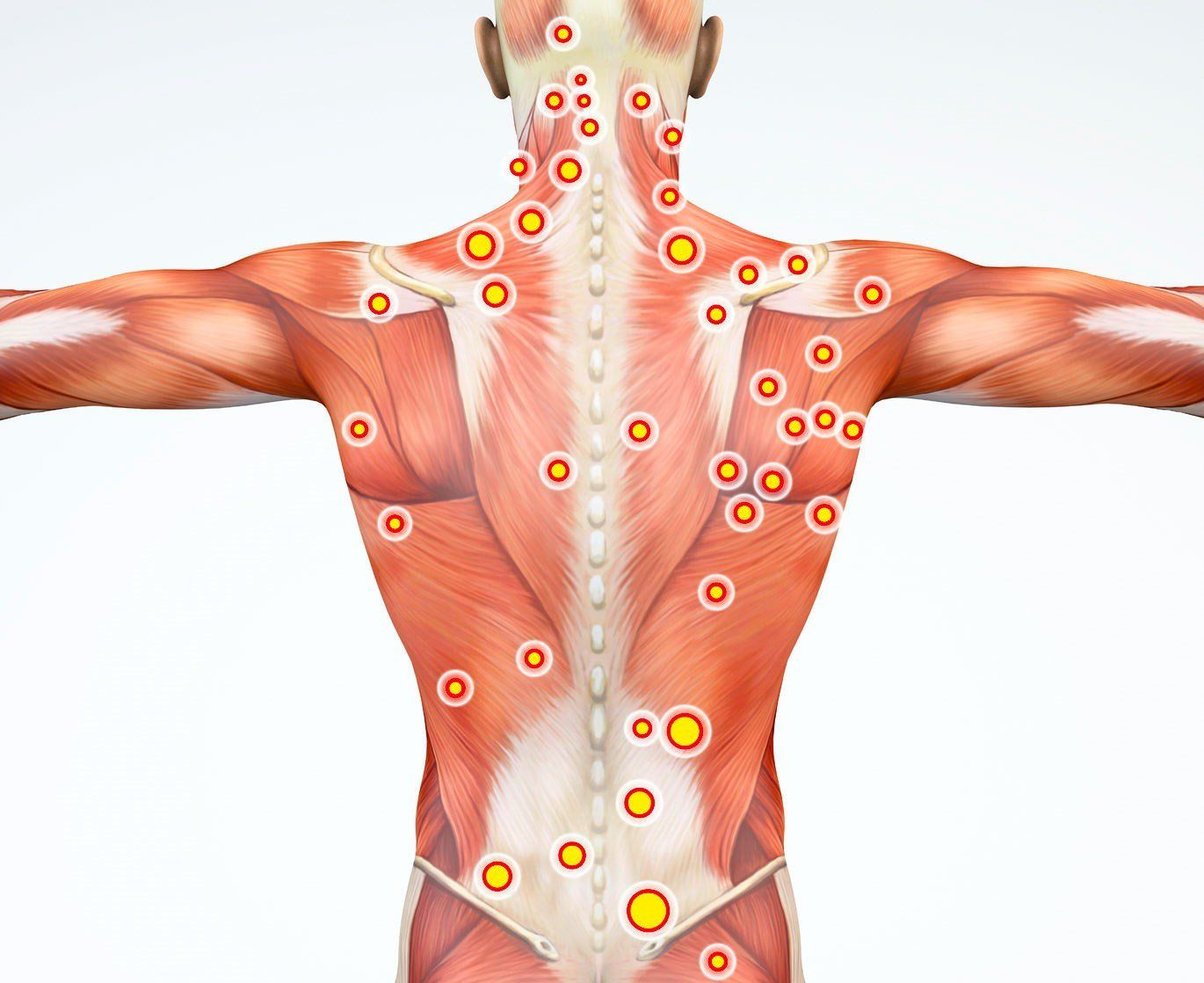
Your upper back’s unique structure explains its vulnerability. Twelve vertebrae (T1-T12) anchor to your rib cage, creating a naturally stable zone designed to shield your heart and lungs—not to bend freely like your neck. When muscles like the rhomboids or trapezius endure prolonged strain from slouched sitting or heavy shoulder bags, they develop painful trigger points that can radiate discomfort into your arms or chest.
Common culprits include monitors positioned below eye level forcing forward head posture, repetitive twisting during sports like golf, or even sudden coughing with poor mechanics. Crucially, this pain rarely stems from discs or joints—it’s usually muscular deconditioning. Without adequate strength in your postural muscles, everyday tasks like lifting groceries overload the thoracic spine, creating that familiar “permanent knot” sensation.
Instant Upper Back Pain Relief Tactics
Ice vs Heat: Your First 48-Hour Decision
Confusion about ice versus heat worsens 80% of cases. Immediately after strain (like sleeping wrong or overexertion), ice reduces inflammation. Wrap an ice pack in a thin towel and apply for 15–20 minutes every 2 hours for the first 48 hours—relief often hits within 5 minutes. After 48 hours, switch to heat to relax muscle spasms: use a heating pad or warm shower stream for 15–20 minutes twice daily.
For chronic pain flaring up, alternate both: 5 minutes cold followed by 5 minutes heat, repeating once. Never apply ice or heat directly to skin, and avoid heat if swelling is present.
OTC Meds That Target Thoracic Pain
Skip random pill-popping. For inflammation-driven pain (sharp, worse with movement), take ibuprofen 200–400 mg with food every 6–8 hours. If stomach sensitivity is an issue, topical diclofenac gel applied directly to knots delivers localized relief without digestive risks. For aching pain without inflammation, acetaminophen 500–1000 mg every 6 hours works better.
Crucially, never combine oral and topical NSAIDs—they overload your system. Limit OTC pain relief to 10 days unless a doctor approves extended use.
5-Minute Desk Rescue Routine (Zero Equipment)
Forget complicated regimens. Every 30 minutes of sitting, perform this sequence to prevent stiffness from escalating into pain:
- Shoulder blade pinches: Sit tall, squeeze shoulder blades together for 5 seconds (10 reps)
- Seated thoracic twists: Clasp hands behind head, rotate left while exhaling (3 reps/side)
- Wall angels: Stand against wall, arms bent 90° like goalposts; slide arms up/down slowly (10 reps)
- Doorway pec stretch: Place forearm on doorframe, gently lean forward until chest opens (30 seconds/side)
- Deep breathing reset: Inhale 4 seconds through nose, exhale 6 seconds through pursed lips (5 cycles)
This routine reverses rounded-shoulder posture by activating dormant mid-back muscles. Do it during phone calls or between meetings—your next ache session might never happen.
Home Exercise Program That Fixes the Root Cause
Warm-Up Flow (2 Minutes)
Begin every session with these movements to prepare stiff tissues:
– Cat-Cow on all fours: Arch and dip spine slowly (10 reps)
– Foam roller extensions: Lie over roller horizontally at mid-back, arms overhead (5 reps)
– Scapular circles: Roll shoulders backward in slow loops (10 reps)
Strength Circuit (3x Weekly)
| Exercise | How to Perform | Why It Works |
|---|---|---|
| Band rows | Anchor band at chest height; pull elbows back while squeezing shoulder blades (12 reps) | Rebuilds rhomboid strength for upright posture |
| Face pulls | Pull resistance band toward face with elbows high; end hands at ear level (12 reps) | Targets rear delts to counter rounded shoulders |
| Wall angels | Maintain contact at head, back, and buttocks while sliding arms up/down wall (10 reps) | Trains serratus anterior for scapular stability |
Perform 2 sets of each exercise. Stop if pain shoots beyond your upper back—this isn’t about pushing through discomfort.
Post-Workout Stretches
Hold each stretch 30 seconds without bouncing:
– Child’s pose with side reach: Kneel, sit back on heels, walk hands left/right to stretch lats
– Upper trap stretch: Gently pull head toward armpit with opposite hand
– Thoracic rotation: Lie on side, top arm sweeps across body toward floor
These release tension built during strengthening. Never skip them—flexibility prevents next-day soreness.
Fix Your Workstation in Under 5 Minutes
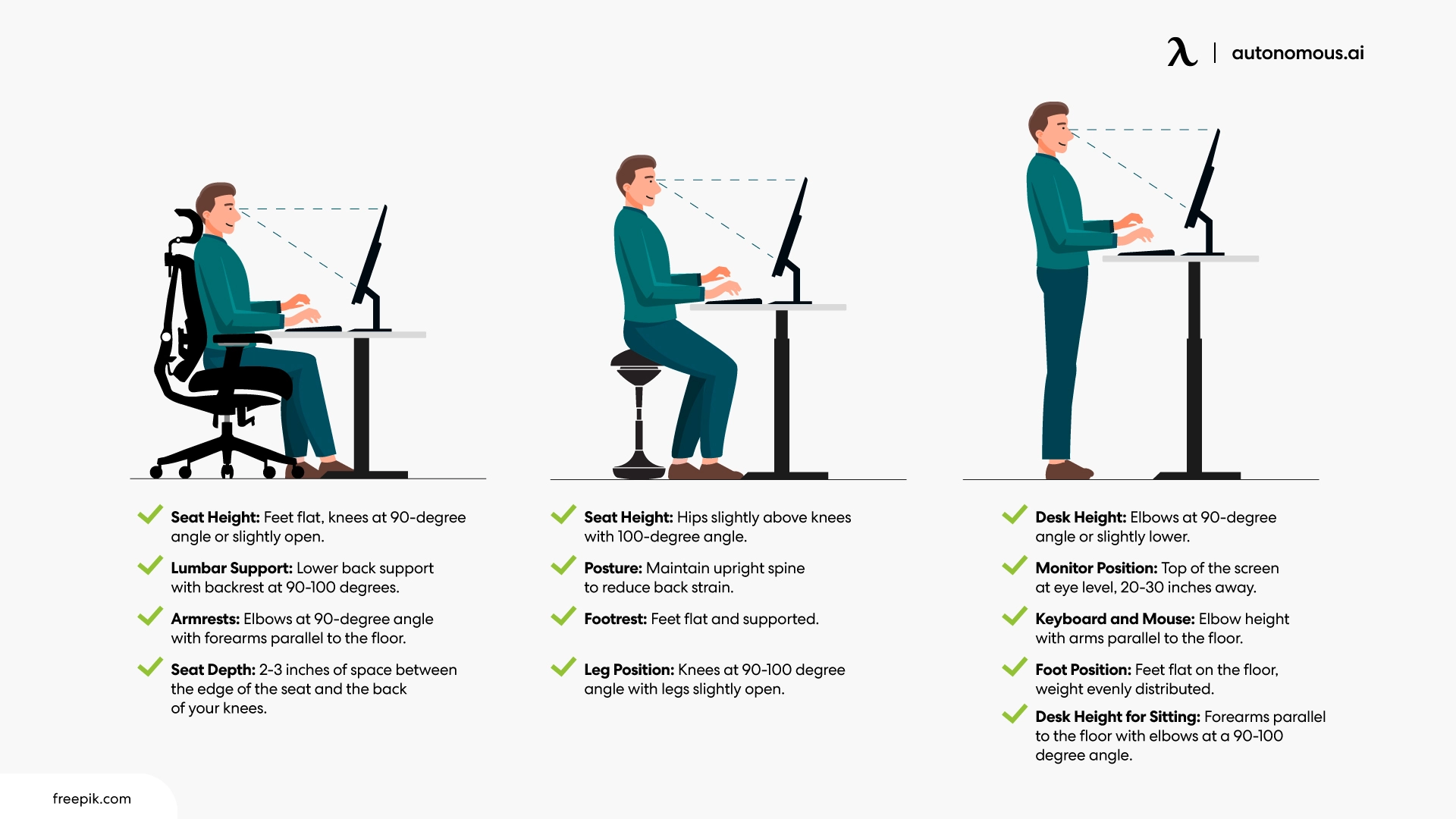
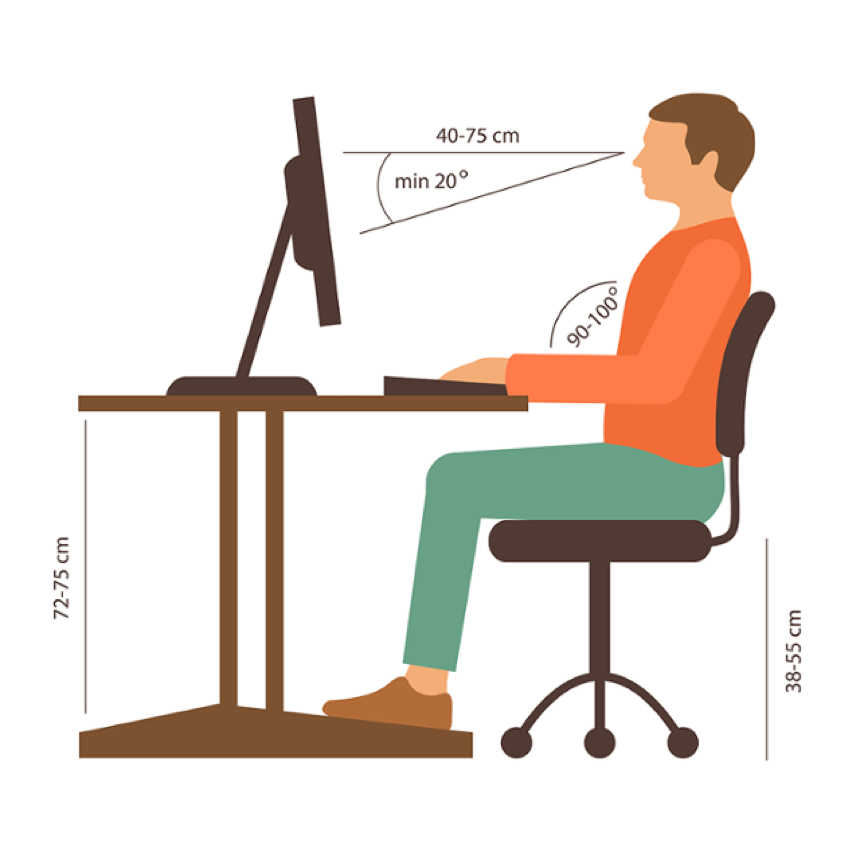
Your desk setup likely fuels your pain. Correct these critical flaws immediately:
1. Elevate monitor to eye level using books under your laptop—prevents forward head tilt
2. Roll a towel for lumbar support if your chair lacks it; place at belt-line height
3. Reposition keyboard so elbows bend at 90° with wrists neutral (not resting on desk edge)
4. Set phone timer for micro-breaks: Stand and pace during every call
These tweaks reduce spinal load by 40%. You’ll feel less fatigue by lunchtime.
Professional Treatments Worth the Investment
Massage That Actually Helps
| Type | When to Choose | Frequency |
|---|---|---|
| Trigger-point therapy | For acute, localized knots | Weekly for 3-4 sessions |
| Myofascial release | For broad, “band-like” tightness | Weekly for 6-8 sessions |
| Foam rolling | For daily maintenance | 5 minutes daily against wall |
Trigger-point work provides faster relief for stubborn knots, while myofascial release improves overall mobility. Pair either with physical therapy for best results.
Physical Therapy Protocol
Effective PT follows a three-phase system:
– Weeks 1-2: Manual joint mobilization + postural drills (3x weekly)
– Weeks 3-4: Resistance band strengthening focusing on scapular control
– Weeks 5-6: Functional training for lifting or sports movements
Most see significant improvement within 3 weeks. If no change occurs after 4 sessions, seek a second opinion—your therapist should tailor exercises to your specific weakness.
Red-Flag Symptoms: Call Doctor Now
Seek immediate care if you experience:
– Night pain that wakes you or resting pain unrelieved by position changes
– Numbness spreading below your waist or bladder/bowel control issues
– Chest pain with shortness of breath (could indicate heart or lung problems)
– Fever with unexplained weight loss or history of cancer
These signal serious conditions like spinal infection or fractures. For typical muscular pain, stick with the self-care strategies outlined here.
Pregnancy-Safe Upper Back Pain Relief
Hormone-driven ligament laxity and shifting weight pull shoulders forward during pregnancy. Modify exercises safely:
– Do seated band rows instead of prone Superman lifts
– Use wall angels standing (avoid lying on back after first trimester)
– Limit heat to 20 minutes at ≤100°F (38°C)
– Sleep with wedge pillow under belly and between knees
Avoid deep tissue massage on the abdomen. Consult your OB-GYN before starting any new routine.
Recovery Timeline Cheat Sheet
| Condition | Expected Healing Time | Action Required |
|---|---|---|
| Muscle strain | 2-6 weeks | Start gentle movement within 24 hours |
| Disc/facet pain | 6-12 weeks | Begin PT immediately; avoid twisting |
| Vertebral fracture | 8-12 weeks | Requires medical imaging and bracing |
Bed rest prolongs recovery—early movement within pain-free ranges speeds healing by 30%. If no improvement occurs after 1 week of consistent self-care, see a physical therapist.
Key Takeaways for Lasting Relief
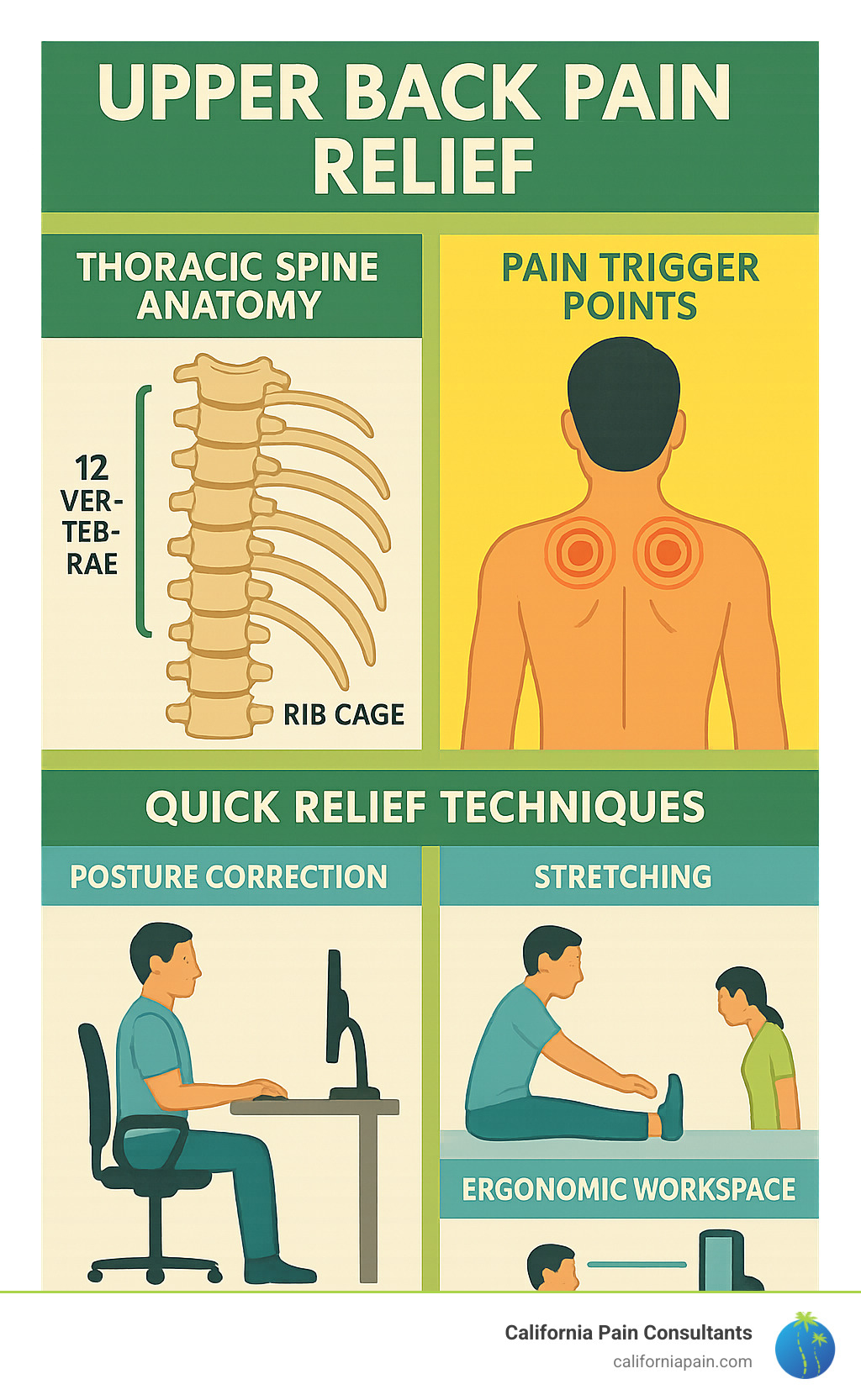
Your upper back pain relief journey succeeds when you combine immediate symptom control with long-term strength building. Ice first 48 hours, then switch to heat—this simple sequence resolves acute flare-ups faster. The band row and wall angel strength circuit prevents 90% of recurrences when performed 3x weekly. Most critically, fixing your monitor height today reduces spinal strain more than any single exercise.
Start with the 5-minute desk rescue now. Within hours, you’ll feel reduced tension. Commit to the strength routine for 4 weeks, and you’ll build a resilient thoracic spine that stays pain-free through workdays, workouts, and life’s demands. Your back isn’t broken—it just needs the right reset.