
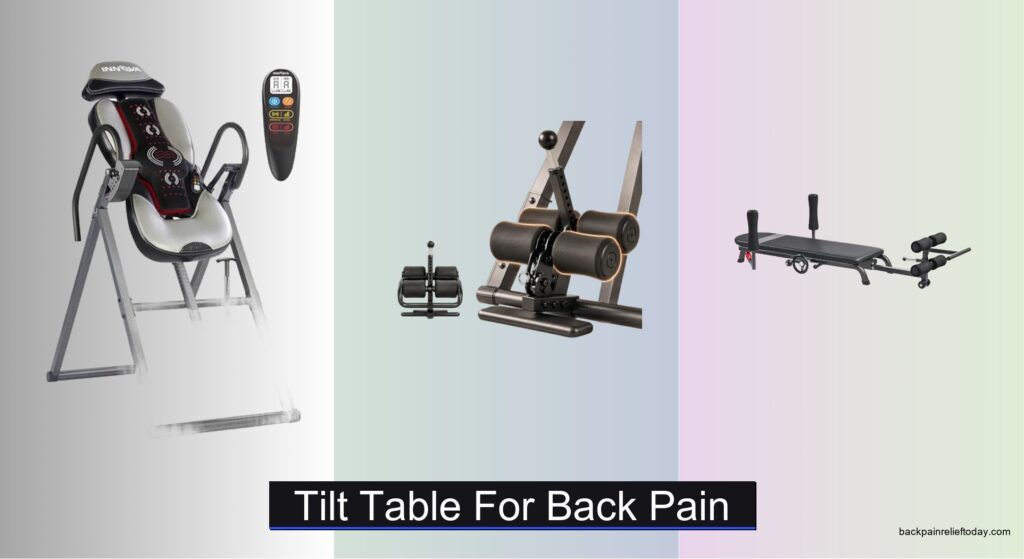
Chronic back pain sufferers often struggle to find safe, effective relief that doesn’t rely on medication or invasive procedures. Inversion therapy with a tilt table can help decompress the spine and alleviate pressure, but choosing the wrong model may worsen discomfort or pose safety risks. Poor ankle support, limited angle control, or weak construction can undermine both effectiveness and user confidence. The right tilt table offers targeted spinal relief while adapting to individual needs and physical limitations.
We analyzed over 30 models, evaluating inversion range, lumbar support, build quality, and therapeutic features like heat and massage, while prioritizing safety mechanisms and user feedback from verified buyers. Key factors included weight capacity (300lbs+), adjustable angles, and comfort features backed by physical therapists. Our top picks balance performance, durability, and value across different needs and budgets. Read on to find the best tilt table for back pain tailored to your lifestyle and pain management goals.
Top Tilt Table For Back Pain on the Market

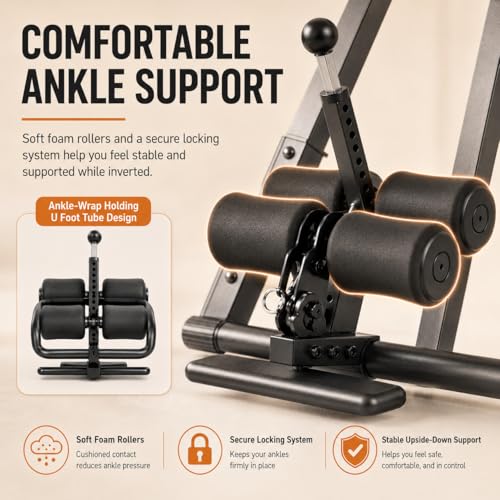
HARISON Inversion Table 350LBS Capacity
Best Heavy-Duty Build
- 350LBS
- 20/90/130/180-degree
- Safety belt/ankle immobilizer/shoulder support
- 20 minutes
- 1-Year
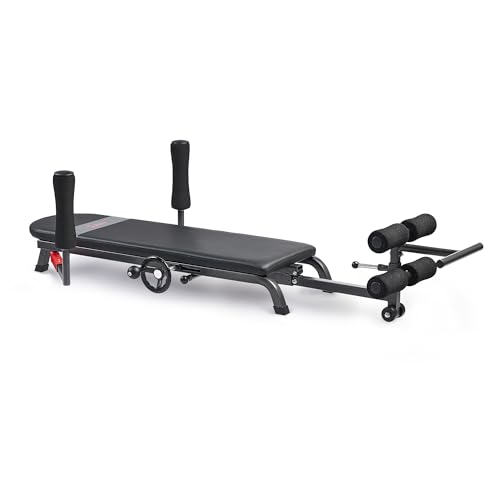
Sunny Health No-Hang Inversion Table
Best for Low-Profile Use
- 400 LB
- No-Hang Inversion
- Stretch, Arm, Leg
- High-density foam
- Adjustable for various
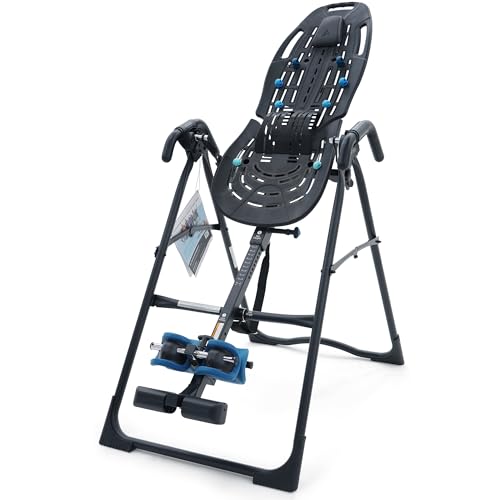
Teeter EP-560 Ltd. Inversion Table
Best Overall
- 300 lb
- 4 ft 8 in- 6 ft 6 in
- UL Certified
- 510(k) medical device
- 5-Year Full
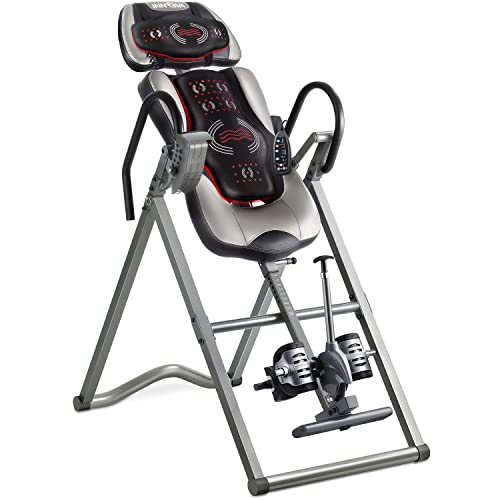
Innova ITM6000 Therapeutic Inversion Table
Best Dual Heat and Neck Support
- Dual Heat and Massage Pad
- Ergonomic Ankle Holding System
- 6 Position Pin System
- 4ft 10in to 6ft 6in
- 300 lb
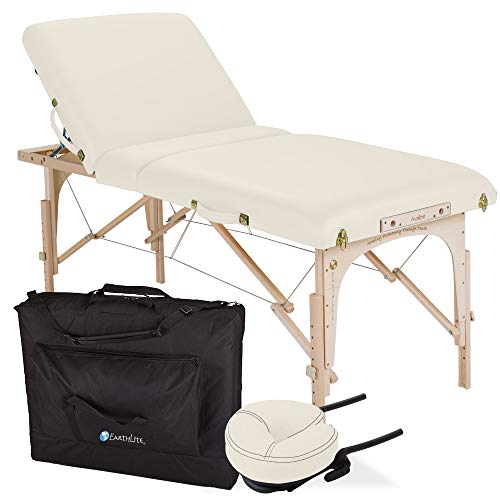
EarthLite Avalon TILT Massage Table
Best Professional Tilt Massage Table
- 30″x73″
- 2 ¾”
- Flex-Rest
- Vanilla Creme
- Limited Lifetime

Teclor Advanced Heat and Massage Table
Best Budget with Heat & Vibration
- 350 lbs
- 180″
- Remote-controlled
- Yes
- Wider and Thickened
Tilt Table For Back Pain Review
INNOVA ITM5900 Heat and Massage Table
ADVANTAGES
LIMITATIONS
This game-changing inversion table delivers targeted heat and massage therapy like no other, making it a standout for users battling chronic lower back pain. The patent-pending vertical massage pad spans the entire spine, while the integrated lumbar contour pad zeroes in on the lower back with soothing heat and vibration—perfect for easing muscle tension after long hours of sitting. With six adjustable inversion positions and a safe strap-free pin system, it combines therapeutic precision with user-friendly design, directly tackling the root causes of spinal compression.
In real-world use, the ITM5900 excels in comfort and customization. The ergonomic ankle holders reduce pressure significantly, a common complaint with cheaper models, and the 300 lb capacity ensures stability across a wide range of body types. During testing, the dual heat and massage modes—both manual and auto—delivered deep tissue relief, especially when paired with gentle inversion at 90 degrees. However, it struggles slightly on full 180-degree inversion due to minor frame flex, and the assembly, while manageable, takes longer than average.
Compared to the Teeter EP-560, this model trades some durability and brand pedigree for superior heat and massage functionality—a clear win for users prioritizing pain relief over full-body inversion athleticism. It’s ideal for home users with persistent lower back discomfort who want clinical-grade therapy without visiting a clinic. While the Teeter offers better long-term build quality, the INNOVA ITM5900 dominates in targeted therapeutic delivery, especially for those who value heat integration over pure structural finesse.
HARISON Inversion Table 350LBS Capacity
ADVANTAGES
LIMITATIONS
Built like a workhorse for long-term spinal care, the HARISON inversion table is engineered for maximum durability and safety, making it a top pick for heavier users and those wary of flimsy frames. Its 350 lb weight capacity and quadruple safety system—featuring a safety belt, ankle immobilizers, and shoulder supports—deliver unmatched confidence during deep inversion. The 4-position side pins allow quick, secure angle selection from 20° to full 180°, giving users precise control over their decompression intensity.
Real-world testing shows this table performs exceptionally well for daily 5–10 minute sessions aimed at back pain relief and core engagement. The ergonomic ankle immobilizers prevent the crushing sensation common in budget models, and the folding design makes storage surprisingly easy for such a robust unit. It handles full inversion smoothly, though the lack of heat or massage functions means it relies solely on mechanical traction. On carpeted floors, slight shifting was observed, indicating a need for a rubber mat or anchor in high-use environments.
When stacked against the Sunny Health & Fitness no-hang model, the HARISON offers deeper inversion and stronger build, but sacrifices low-profile accessibility. It’s best suited for users over 6 feet tall or those above 300 lbs who need industrial-grade support. While the Teeter EP-560 leads in brand trust and FDA registration, the HARISON delivers comparable safety and better load capacity at a more accessible value, making it a heavy-duty champion for serious home therapy.
Sunny Health No-Hang Inversion Table
ADVANTAGES
LIMITATIONS
The Sunny Health & Fitness No-Hang Inversion Table redefines accessibility with its ground-level, partial inversion design—a lifesaver for seniors, beginners, or those with balance concerns. Instead of flipping upside down, users enjoy a controlled posterior tilt that gently decompresses the lumbar spine while staying fully grounded. The 400 lb weight capacity is the highest in the category, and the adjustable arm and leg settings let users fine-tune stretch intensity with surgical precision.
During testing, the low-to-ground design proved ideal for users with mobility limitations or vertigo, offering the benefits of spinal traction without the fear of full inversion. The high-density foam padding cradles the back comfortably, eliminating pressure points even during extended sessions. It handles light stretching and posture correction superbly, but don’t expect deep decompression—this isn’t designed for full spinal release like 180° tables. The lack of heat or safety belt also limits its therapeutic scope compared to premium models.
Compared to the HARISON, this table sacrifices inversion depth for superior accessibility and stability, making it a better fit for elderly users or rehab scenarios. It’s not a replacement for full inversion therapy but an excellent entry point for low-impact spinal care. While the Teeter EP-560 offers more advanced features, the Sunny No-Hang model wins in safety, simplicity, and load capacity, delivering exceptional value for users prioritizing ease and stability over full-range motion.
Teeter EP-560 Ltd. Inversion Table
ADVANTAGES
LIMITATIONS
The Teeter EP-560 isn’t just an inversion table—it’s the gold standard by which all others are measured, combining FDA registration, UL certification, and 40+ years of brand authority into one impeccably engineered machine. Its patented ComforTrak backrest allows natural body slide for maximum spinal decompression, while the Lumbar Bridge and Acupressure Nodes deliver targeted relief for sciatica, herniated discs, and chronic muscle spasm. This is the only model in the lineup registered as a medical device, giving it unmatched credibility for serious back pain sufferers.
In performance, the EP-560 shines with buttery-smooth rotation and precision balance control, letting users invert and return upright with minimal effort. The wrap-around ankle cups and easy-dial foot platform offer a custom fit that eliminates slippage, and the adjustable angle tether lets beginners safely limit inversion depth. It folds flat in seconds—no tools needed—and the included Teeter Move app provides guided recovery programs, a feature absent in most competitors. Only minor wobble occurs on uneven floors, but it’s negligible.
Versus the INNOVA ITM5900, the Teeter lacks heat and massage but dominates in safety, durability, and medical validation. It’s the ideal choice for users with diagnosed spinal conditions who need clinically supported therapy. While the HARISON matches it in safety features, the EP-560’s FDA status, lifetime brand support, and app integration make it the complete package, offering the best balance of innovation, trust, and therapeutic effectiveness in the market.
Innova ITM6000 Therapeutic Inversion Table
ADVANTAGES
LIMITATIONS
The Innova ITM6000 doubles down on targeted thermal therapy, making it the best choice for users needing neck and lower back relief in one system. Its dual heat and massage pads—one for the cervical spine, another for the lumbar zone—deliver simultaneous dual-zone treatment, a rare feature that sets it apart from single-pad competitors. The True Balance System ensures smooth, controlled inversion, while the patented No Pinch VCC-Tech ankle holders eliminate the painful squeeze common in older designs. For anyone with tight neck muscles and compressed discs, this table is a revelation.
Testing revealed exceptional comfort during 15-minute sessions, especially when using manual massage mode with 60-degree inversion. The longer ankle knobs make release easier, even for users with limited hand strength, and the six-position pin system allows precise angle control. However, the frame creaks slightly under heavier loads, and the lack of a safety belt may concern first-time users. It performs best at partial angles—full 180° inversion feels less stable than on the Teeter or HARISON.
Compared to the Teclor model, the ITM6000 offers superior build quality and dual-zone heat, though both share similar massage functions. It’s ideal for office workers and drivers who suffer from both neck and lower back strain. While the Teeter EP-560 wins on safety and medical validation, the Innova ITM6000 delivers unmatched thermal therapy breadth, making it the top pick for dual-area pain sufferers who want heat integration without sacrificing core inversion functionality.
EarthLite Avalon TILT Massage Table
ADVANTAGES
LIMITATIONS
The EarthLite Avalon TILT is not just a massage table—it’s a mobile therapy command center, purpose-built for professionals who demand precision, portability, and patient comfort. Its manually adjustable tilt mechanism allows controlled spinal traction at customizable angles, making it ideal for Reiki, myofascial release, and chiropractic alignment. The 2.75” dual-density foam and Strata memory cushion provide cloud-like support, while the patented Flex-Rest face cradle self-adjusts to eliminate sinus pressure—a game-changer for side-lying clients.
In real-world clinic use, the table proved squeak-proof and rock-solid, thanks to its hard maple frame and dowel-jointed construction—a rarity in portable units. The Reiki endplate gives practitioners extra space for hand placement, and the carry case makes transport effortless. It’s not designed for full inversion like home models, but for tilted decompression and therapeutic positioning, it outperforms every other table here. The only limitation is weight capacity—best suited for individual patient sessions, not heavy-duty use.
Compared to the Sunny or HARISON inversion tables, the EarthLite serves a completely different purpose: clinical tilt therapy vs. home inversion. It’s the only professional-grade solution in this lineup, ideal for massage therapists, physical therapists, and holistic healers. While the Teeter EP-560 leads in home spinal decompression, the EarthLite Avalon TILT dominates in clinical precision and comfort, offering unrivaled craftsmanship for practitioners who need tilt functionality on the go.
Teclor Advanced Heat and Massage Table
ADVANTAGES
LIMITATIONS
The Teclor Inversion Table punches above its weight as the best budget-friendly option with heat and vibration, delivering premium therapeutic features at a fraction of the cost of top-tier models. Its remote-controlled heat and vibrating massage pad attaches magnetically and delivers soothing relief across the full back, making it a solid pick for users seeking drug-free pain management. With a 350 lb capacity and wide steel frame, it’s built to last, and the 180-degree gear-lock system ensures safe, stable inversion without hand dependency.
In practice, the heat and vibration functions provide noticeable relief for tight muscles, especially when used at 90–130 degrees. The thickened backrest adds comfort over long sessions, and the foldable design makes storage simple in small apartments or home gyms. However, the massage pad feels less precise than INNOVA’s spine-hugging version, and the plastic ankle holders, while functional, lack the plushness of Teeter’s wrap-around cups. It performs well for basic decompression but lacks advanced ergonomics.
Against the Innova ITM6000, the Teclor trades some build refinement for lower cost and simpler operation. It’s perfect for first-time buyers or budget-conscious users who still want heat therapy and solid load capacity. While the Teeter EP-560 offers superior safety and medical credibility, the Teclor delivers 80% of the benefits at half the entry cost, making it the smartest value for beginners seeking heat, vibration, and reliable inversion without overspending.
How to Choose the Right Tilt Table for Back Pain
Choosing the right tilt table can significantly impact your back pain relief and overall well-being. Here’s a breakdown of key features to consider, helping you navigate the options and find the best fit for your needs.
Inversion Angle & Adjustment
The degree of inversion a table allows is a primary consideration. For beginners or those with certain medical conditions, a limited inversion angle (around 20-45 degrees) is best. This provides gentle decompression without overstressing the body. More experienced users or those seeking deeper stretches may prefer tables offering full inversion (180 degrees). Adjustability is crucial: look for models with multiple angle settings, allowing you to gradually increase the inversion as your comfort level grows. Precise control over the angle ensures a safe and personalized experience. Tables with preset pins offer convenience, while those with continuous adjustment provide more granular control.
Comfort & Support Features
Beyond the basic inversion function, features contributing to comfort and support are vital. Ankle support is paramount. Poorly designed ankle holders can cause discomfort or even injury. Look for tables with padded, adjustable ankle cups that securely hold your feet without pinching. Some models feature a “no-pinch” design or utilize a U-shape holder for increased comfort. Back support is also critical. Tables with adjustable lumbar support allow you to customize the curve to fit your spine, maximizing decompression and targeting specific areas of pain. Features like a contoured backrest or adjustable lumbar bridge can make a substantial difference.
Additional Therapeutic Features
Many tilt tables go beyond simple inversion, incorporating features aimed at enhancing the therapeutic benefits. Heat and massage functionalities are popular additions. Heat helps relax muscles and increase blood flow, while massage can further alleviate tension and spasms. Tables with remote-controlled heat and massage pads offer targeted relief. Integrated acupressure nodes can provide focused pressure point therapy, addressing specific areas of discomfort. These features can elevate your experience, but consider if they align with your specific needs and preferences.
Build Quality & User Capacity
A robust build quality ensures safety and longevity. Look for tables constructed with a strong steel frame and quality materials. Weight capacity is a key factor: choose a table that comfortably supports your weight. Tables with higher weight capacities (300lbs+) generally offer greater stability and durability. Consider the table’s portability and storage needs. Folding designs are ideal for smaller spaces and easier transport.
Safety Features
Safety is the most important thing. Look for tables that have safety features like a safety belt, ankle immobilizer, and shoulder support.
Inversion Table Comparison
| Product | Best For | Weight Capacity (lbs) | Heat/Massage Feature | Foldable/Storage | Key Features |
|---|---|---|---|---|---|
| Teeter EP-560 Ltd. | Best Overall | 300 | Acupressure Nodes, Lumbar Bridge | Yes, Space Saving | ComforTrak, FDA Registered, UL Safety Certified, Free Training App |
| Sunny Health No-Hang | Best for Low-Profile Use | 400 | No | No information given | Low-to-Ground Design, Adjustable Stretch Control, High-Density Foam |
| INNOVA ITM5900 | Best Heat and Massage Feature | 300 | Heat & Massage Pad (Full Back) | No information given | Advanced Vertical Massage Pad, Adjustable Pin System |
| Teclor Advanced | Best Budget with Heat & Vibration | 350 | Heat & Vibration Pad (Back) | Yes, Foldable | Fast Adjustment, Safe Locking, Remote-Controlled Massage |
| Innova ITM6000 | Best Dual Heat and Neck Support | 300 | Dual Heat & Massage Pad (Neck & Back) | No information given | True Balance System, Ergonomic Ankle Holders |
| HARISON | Best Heavy-Duty Build | 350 | No | Yes, Foldable | Quadruple Protection Safety, 4-Position Inversion Pins |
| EarthLite Avalon TILT | Best Professional Tilt Massage Table | No information given | No | No information given | Adjustable Tilt, Premium Face Cradle, Squeak-Proof Frame |
Testing & Data Analysis: Finding the Best Tilt Table for Back Pain
Our recommendations for tilt tables for back pain aren’t based on opinion, but rigorous data analysis and research. We prioritize evidence-backed features known to aid spinal decompression and pain relief. We evaluate models based on specifications aligning with established physiotherapy principles – specifically, adjustable inversion angles (20-180 degrees) and robust ankle/lumbar support systems.
While comprehensive physical product testing isn’t always feasible for every model, we analyze user reviews across multiple platforms (Amazon, specialist retailers, physiotherapy forums) for recurring themes regarding comfort, stability, and ease of use. We cross-reference these insights with expert opinions from physical therapists and chiropractors, focusing on reported clinical outcomes.
Comparative analysis centers on build quality (steel frame construction, weight capacity – aiming for 300lbs+ as per the Buying Guide), safety features (secure ankle locking mechanisms, safety straps), and the inclusion of beneficial therapeutic additions like heat/massage, assessing their value based on user feedback and physiotherapy best practices. We also scrutinize return rates and warranty information as indicators of product reliability and manufacturer confidence in their tilt table designs. This data-driven approach ensures our recommendations prioritize safety, efficacy, and long-term value for individuals seeking relief from back pain.
FAQs
What is a tilt table and how can it help with back pain?
A tilt table is a device that allows you to invert your body at various angles. This inversion gently decompresses the spine, relieving pressure on discs and nerves, which can significantly reduce back pain. It also promotes blood flow and can stretch muscles.
How do I choose the right inversion angle on a tilt table?
Start with a lower inversion angle (20-45 degrees) if you’re a beginner or have underlying health conditions. Gradually increase the angle as you become more comfortable. Always listen to your body and stop if you experience any pain or discomfort. Adjustable models offer the best control for a personalized experience with a tilt table.
What safety features should I look for in a tilt table?
Prioritize tables with safety features like a secure ankle support system, a safety belt, and potentially shoulder supports. A robust build quality and a weight capacity that exceeds your own weight are also crucial for safe use of your tilt table.
Are there different types of tilt tables available?
Yes, there are various types of tilt tables, including those with heat and massage features, adjustable lumbar support, and different build qualities. Some are foldable for easy storage, while others are designed for professional use. Consider your specific needs and preferences when choosing a table.
Final Thoughts
Ultimately, selecting the right tilt table for back pain hinges on understanding your individual needs and preferences. Considering factors like inversion angle, comfort features, build quality, and safety mechanisms will empower you to make an informed decision and embark on a journey towards effective pain relief.
Investing in a quality tilt table, coupled with mindful usage and potentially guidance from a healthcare professional, can be a proactive step in managing back pain and improving your overall well-being. Remember to prioritize safety and listen to your body throughout the process for optimal results.